Showing posts with label Brad Pitt. Show all posts

Sunday, 11 August 2019

INGLOURIOUS BASTERDS: TARANTINO’S WORLD WAR II CAPER A DECADE ON


When Quentin Tarantino screened his widely anticipated WWII movie Inglourious Basterds at the 2009 Cannes Film Festival, critics were divided and mostly perplexed. When the film opened wide in August that same year the reviews were mostly still mixed by the same critics and yet this was the writer/director’s biggest box office hit to date and a firm fan favourite almost immediately. As time has gone on and the ten year anniversary of its general release is upon us, I look back at the lasting appeal of the film and how it has endured despite its subversive, outrageous, and uncommercial sensibilities. 

The film tells the story of two seperate plans to assassinate members of the Nazi high command at a Nazi Propaganda film premiere during occupied France in 1944. It charts the personal quest for vengeance of a young Jewish woman, Shosanna (
Mélanie Laurent), who in the film’s 1941 setup, is the sole survivor of her family’s execution by Col Hans Landa (Christoph Waltz). Elsewhere in France during this time, America has joined the war and we follow a Jewish military unit (The Basterds) led by Lt Aldo Raine (Brad Pitt) behind enemy lines as their shocking fear tactics that make waves felt as far up as Hitler himself. As the film dovetails and hurtles towards its explosive finale, fates converge and history is altered forever under the roof of a cinema, the only place where anything can happen. 

The film is mostly remembered now by the extraordinary performance of Austrian actor Christoph Waltz as Col. Hans Landa; an SS Officer who is the film’s main villainous drive. Waltz, a virtual unknown at the time of casting famously said to his director, “Thank you for giving me my career”, to which Tarantino responded, “Thank you, for giving me my movie”.

It’s true that production on Basterds was only a week from being shut down during casting; it appeared Tarantino had written a character so devilishly talented in linguistics that it was impossible to find an actor who could both speak four languages and deliver everything else the script demanded. Thankfully fate intervened and careers were revived on both sides of the camera. Landa is arguably the greatest character of Tarantino’s career, from a body of work that has boasted many memorable characters. But although it’s the villainous Landa who remains the main pop-culture touchstone of the piece and the pinnacle of Tarantino’s career, the film boasts many delights.

Like the heist film without a heist that was Reservoir Dogs, Tarantino’s long awaited ‘men-on-a-mission’ WWII actioner that had been talked up since 1998 was devoid of notable warfare. The film still functioned somewhat as a men-on-a-mission style caper but was also a Spaghetti Western-style revenge story, a spy thriller, an examination of Nazi Propaganda, as well as a love letter to cinema itself.

From the moments that Nick Perito's rendition of ‘The Green Leaves of Summer’ accompanies the opening credits.


To the beautiful fairytale like vistas of the opening shot.


To the broken tranquility when Ennio Morricone’s music introduces the approaching doom.


It’s clear that Tarantino is in pure command of melding all these scattered elements into something special.

The opening chapter ‘Once Upon a Time...in Nazi-occupied France’ opens to ideallic greener-than-green vistas of French cow-country and the film sets the expectation of a fairytale that encourages us to leave grounded reality at the door. ‘The Green Leaves of Summer’ was most famously used to open The Alamo (1960) a John Wayne western that famously took historical liberties with the 1836 account of outnumbered American’s defending against thousands of Mexican aggressors. This ties into the later pivotal war story of Frederich Zoller as well as the film’s later history bending directions. When Ennio Morricone’s ‘La Condanna’ (from 1966 Spaghetti Western The Big Gundown) enters to warn of approaching evil, it seamlessly merges, with Morricone’s sampling of Beethoven’s ‘Fur Elise’, both Western and German insignias.


“Landa is the best character I’ve written and maybe the best I ever will write” - Quentin Tarantino

It’s a masterclass of a scene. Tarantino’s penchant for dialogue is too often the forefront of any conversation and yet his mastery of silences and expressions are seldom the focus; The look on the farmer’s face as the Nazi vehicles approach, the look between his daughters’s before they’re asked to leave the farmhouse. The scene is a mystery to anyone watching for the first time, it’s a polite enough exchange between two strangers and yet the atmosphere is the feeling of someone’s worst nightmare, of that day they feared could come. The niceties slip soon enough as Landa enters into a monologue explaining why Jews are despised such as rats are, a preposterous point so levelled in its delivery that the delusional ideology sounds madly reasonable and evident why it could be used to justify a hateful doctrine. Of the film’s 153 minute runtime the opening segment is an excruciating twenty-one minutes and serves as a nerve shredding intro to the story’s main villain (Landa) and protagonist (Shosanna). It’s the first of multiple nail-biting set-pieces and interrogations used to introduce and reveal characters, building to the final chapter under Shosanna’s Parisian Cinema.

At the heart of Basterds is a Nazi Propaganda film - Nations Pride - directed by the real-life Minister of Propaganda Joseph Goebells about the exploits of fictional war hero Frederich Zoller. It’s an onslaught of a film that shows hundreds of American soldiers maimed by a single Nazi sniper. The theatre full of the Nazi Party is electrified, Hitler himself is in fits of joyful bloodlust, and then the tables are turned as hundreds of Nazis are gunned down and burnt to death in the climax. The bloodlust is now on us as we enjoy the carnage, the violent catharsis of it all, the escapist ecstasy of a more satisfying end to the war. The fantasy of revenge is as much a fantasy as living in a world where violence doesn’t provide solutions and the meta-effect of the film speaks to the viewer and asks, ‘it feels good doesn’t it?’ The narrative of Inglourious Basterds itself is a propaganda film, how Tarantino showcases Lt Aldo Raine’s exploits are no different from how Goebells showcases Zoller’s. It's not even a far push to assume upon returning to America that Aldo would be greeted with a post-war career similar to that of Frederich Zoller and do wonders for US Military recruitment and morale. A Russian doll effect even takes shape when considering that Shosanna hijacks Goebell’s film and inserts her own message, making Inglourious Basterds a Jewish propaganda film inside a Nazi propaganda film inside an American propaganda film.


“It seems to me that television is exactly like a gun. Your enjoyment of it is determined by which end of it you're on.” - Alfred Hitchcock


It's clear how the film takes a levelled look at the Nazi soldiers throughout; it has fun making them look, obvious absurd racial beliefs included, pompous and egotistical but never less than deadly. Frederich Zoller would be easy to depict as a tunnel visioned political social climber who boasts of his kill count that’s hooked the attention of Goebells, yet he’s painted as a love sick puppy dog barking up the wrong tree during his pursuit of Shosanna. He’s even introduced as a budding cinephile to Shosanna, who could not be less interested in a man in a Nazi uniform, a factor he pig-headidly fails to comprehend and one that ends up being both their undoings. The narrative almost entirely rests on this monstrous oversight of hubris. Zoller is killed by Shosanna because his affection for her blinded him from the questionable moral weight of his uniform. Shosanna is killed by Zoller because for a single moment she pities him and for the first time sees a man through his uniform. While the film does a great job of providing cathartic turns showing totalitarian extremist figures as jokes (this is sometimes the only way to wound Evil) it acknowledges the danger of losing sight, even for a second the severity of their threat. If it weren't for his uniform the audience would be cheering Frederich to 'get-the-girl' like any other cinematic romance!


Whereas Inglourious Basterd’s opening chapter went down as a notable masterclass even by the film’s own detractors, it as a whole divided critics. Upon release the film was often maligned for being a retread of Tarantino’s previous two ‘lighter’ releases (Kill Bill and Death Proof), this time using the WWII backdrop as a poor excuse to inflict a third dose of violent retribution. The verdict was out if whether Basterds as a return to form but even the more favorable critics often summed it up as a revenge fantasy narrative. Looking at the film this simply is to undermine the way it explores other complex themes.

With Tarantino’s subsequent films - Django Unchained and The Hateful Eight - we can see Basterds clearer than we could ten years ago. The preoccupations of his racially charged westerns are built upon the foundations set here as they explore our relationship with history through genre-cinema, the necessity of violence, and how certain types of violence find their place on and off of the screen.

Django Unchained followed a freed slave on the path to retrieving his wife from her cruel plantation owner. The film offers many pleasures in seeing the downtrodden rise up but Django’s nobel quest for his wife was only possible if he became more dangerous and single minded than the white captors. White blood will spill and if black blood has to as well then so be it, as he is owed what is his. It’s a cinematic fantasy, like Basterds, in that the world can be made right by an individual (or individuals) who enforce their right more heavily than those enforcing against them.

The Hateful Eight, Tarantino’s second western, explores the issue of systematic justice verses vigilantism explored in his first.


“The man who pulls the lever that breaks your neck will be a dispassionate man. And that dispassion is the very essence of justice. For justice delivered without dispassion is always in danger of not being justice" - Oswaldo Mobray (The Hateful Eight)


The fact that the above quote is delivered by character Oswaldo Mobray, an outlaw posing as a court official, doesn’t make it any less true. The world is built up of intricate laws and systems that allowed the unimaginable horror of the Holocaust, the same can be said of slavery and of most injustice still felt today. Inglourious Basterds is revelling in the power of cinema here, of noting the power of the image as propaganda but also of its power to give us the feeling of balance that real life so rarely gives us. In reality the system fails us, the wrong person goes to prison, the guilty enjoy freedom, the rich make bail, Hitler doesn’t face tribunal but takes his own life. Cinema has the power to provide a feeling of closure, no matter how ethereal.


Released within the same decade as 9/11, Basterds naturally attracted comparisons to ongoing current events with a central plot involving US Soldiers undergoing a suicide bombing mission. The Iraq war was still ongoing along with critical humanitarian debates regarding torture as a tool to prevent greater threat to life. Here we're presented with a garish depiction of American warfare, one which uses sheer brutality to extract information. American suicide bombers isn’t the only way the film plays it on the other foot, either; In fact if the above is pure coincidence then there are other examples where Basterds used a European mirror to reflect US history. The fact that Hitler is killed in a theatre box by surprise gunfire reminds of President Lincoln’s Assassination by the hands of John Wilkes Booth in 1865. Then there’s the obvious subtextual reading of King Kong (1933) by Major Hellstrom during the film's now infamous 'La Louisiana Tavern' sequence in which the SS Major smuggly acknowledges the film's story as a metaphor for the enslavement of Africans in America. A sly reference that remind the viewer that no matter how much mileage the Nazis have given cinema for villany, that America pre-dated the Jewish Holocaust with not only one but two of their own if you also add in the genocide of Native Americans. Tarantino even applies the classic stereotypically racist southern-hillbilly profile to Pitt’s Lt Aldo Raine, turning the idea on its head as Raine, unnerving as he is, hates what the Nazi Party believe in and is proud to fight them.

When I first saw Inglourious Basterds it was clear that Tarantino was operating on a new level and this was also the summation of everything made before it. It was razor sharp, focussed, and confident in a way that surpassed his other films; a stranglehold with moments of ecstatic delight. I was reminded that this was a 'come back' vehicle and yet it's remarkable only a third is spoken in English, Brad Pitt its only notable star and is essentially a supporting role, and it references European history and pre-war cinema without ego or condescension. Of its 153minutes the plot only emerges somewhat over an hour in and its action (finale not including) is sparse. What other director could or would make their biggest commercial hit out of such material? This was anarchic filmmaking reminding that there are rules to cinema that are optional to follow and yet the ghosts of cinema's forefathers such as Fritz Lang, Ernst Lubtich, and Alfred Hitchcock, among others, are felt in every frame reminding of cinema's oldest tricks and formalities. How Tarantino juggles the artificial pleasures of cinema while maintaining high drama will always, for me, be his greatest skill.

Viewed today in preparation to write this piece, the film seems more important and impressive than ever. In the last four years the World has become more extreme and yet never so muddied as Presidents are replaced by reality stars, celebrities are replaced by influencers, and as the screens of our attention are getting smaller and smaller the more we're being controlled by them. In a time where everyone is plugged into their own private reality that can be controlled by totalitarian extremists, with its own version of historic events and focus on wartime propaganda, Inglourious Basterds appears all the more prescient when viewed during the ‘fake news’ of today.


Much emphasis has been put on the film's escapist fantasy fulfilment. Today the film's fantasy seems more important and relevant than ever; A victory for the film and a sad fact for Planet Earth. Unlike the survivors of one of Lt Aldo Raine's ambushes, those who seek to oppress and control the masses bare no discernible mark to warn of, don't wear a uniform to speak of, and like history has taught us, hide in plain sight until it's too late. To wish life was that easy truly is a fantasy.

Thursday, 27 September 2012

Killing Them Softly (2012, Andrew Dominik)


George V. Higgins' 1974 pulp-crime novel Cogan's Trade gets a modern revamping with an intensified sociopolitical twist in Andrew Dominik's newly titled Killing Them Softly. Though the underlying themes of this microcosmic tale of retribution are often as on-the-nose as some of the harsh hits throughout, with its ambitions fully realised and the help of an outsider's eye it transcends its genre trappings making one of the most aspiring crime pictures in many years.

An ex-con hires two younger men to hit a mob-protected poker game after second guessing the direction of the mob's counterblow, an outcome that will go in the three's favour as they leave clean with $50,000. In steps Jackie Cogan (Brad Pitt) also hired, this time by the mob to find those responsible for the robbery. Jackie is an intriguing kind of enforcer, an intermediator of both political and financial wellbeing playing off public (street) perception to see that business carries on as usual without truth disrupting commerce.

Killing Them Softly certainly concerns itself with contemporary politics, the current economic climate, and the ramifications on the business sector; organised crime is presented candidly here as a delicate business also under the strain of the recession. It is, after all, a trade like any other and despite the gun welding personnel of the involved, their finances are not bulletproof either. Writer/director Andrew Dominik has stated that he has always viewed crime films as a representation of capitalism, that no other genre acceptably features central characters selfishly crusading for personal gain. Dominik's point might seem patent at first but is entirely accurate, especially as he takes this underlying theme and pushes it to the forefront be be examined and exerted in his film, making an airtight case. The results are severe in both execution and effect, with Obama's (then campaigning for presidency) speeches providing regular commentary on the desperate acts of violence displayed throughout the film.

The film is hardly homework, though, requiring not even a basic knowledge of current political happenings to enjoy. Filling in for the overly simple plot is an incredible array of characters expertly played by a note perfect ensemble; Ben Mendelsohn (Animal Kingdom) and Scoot McNairy (Monsters) are wonderful as the depraved duo who hold up the poker game, their bumbling and sophomoric sensibilities providing the majority of the film's laughs. While James Gandolfini steals the show with a short appearance as Jackie's old friend, flown in to take care of an organised hit. Though staggeringly funny at times, his Mickey is a broken man whose misfortune has crippled him, figuratively speaking. His outward musings of his thin marriage and the possibility of doing more time is delivered with such heart and conviction that this unlikable man introduced for a matter of minutes becomes a tragically sympathetic character who's zest and professonality has gone down with the economy. His choice of business has destroyed him. Brad Pitt hardly leads the show but his Jackie Cogan is interesting beyond the instantly classic exterior; Jackie is capable of great violence but unlike the others likes to remain distant, often physically distant, but also away from the emotions that death can bring. Jackie comforts his prey to a degree, easing them into a false sense of security before the deathblow.

There is a sadness, a biting nihilism to the story and a desolate bleak atmosphere expertly maintained from start to finish. Dominik and director of photography Greig Fraser give Killing Them Softly a fitting end-of-the-world vibe that sticks even through the film's many successful bouts of humour. The film also includes some visually arresting moments (some effective with others falling on unnecessary) to heighten the humdrum nature of the story, especially during more violent moments where he never fails to make you flinch. It's reassuring to know that a filmmaker can still make violence uneasy to an audience. Even his off-key treatment of the opening credits stands you on edge before the first shot has even been fired.

Killing Them Softly is an unapologetic indictment of the 'American Dream', hardly new territory or much to be proud of by now. Given the almost alien representation of the America we're used to seeing through Hollywood, the film's desolate locales, the morally devoid characters, and the bitterly infused words of Brad Pitt in the film's final line, we get an uncharacteristically ambitious crime film that plans to entertain as well as backup its ideology and succeeds at doing both. Whether Killing Them Softly will gain a major audience from its food-for-thought approach to genre filmmaking, we can only hope, as this is a cut above the rest and Andrew Dominik is now going 3 for 3.

Thursday, 26 April 2012

Moneyball (2011, Bennett Miller)


Moneyball is one of the hardest movie pitches of recent years. Not only does it centre around Baseball (a sport hardly followed or loved by most of the world) but it barely even classifies as a sports film, yes it's about Baseball but it hardly features any at all. It focusses on the economics off the pitch and follows the true story of Billy Beane (played here by Brad Pitt) an ex-player now manager of the Oakland Athletics, a struggling team who have once again lost out at the postseason. With failure still fresh on the mind and three of the team's most valued players jumping ship, Billy knows the current formula isn't working and radical turnaround is the cure.


Beane finds the man he's looking for in young economics graduate Peter Brand (Jonah Hill), after his current team of talent scouts meet his ambitious demands for expensive restructure with blank discord. After both Beane and Brand realise they're on the same page and know an unthought of recipe for success, Brand comes over to the Oakland team to change the sport forever. So why should we care about a sports movie that predominantly swaps on-pitch action and rooting for maths and people sitting at desks or on the phone? Aaron Sorkin is the reason why, as he gives Moneyball the same treatment as The Social Network - making a seemingly impenetrable area of interest into a multilayered and thoroughly enjoyable experience. Joined this time by Steven Zailian on writing duties, the pair construct a story of universial themes with added commentary on the modern business side of sport. Themes of regret, failure, ambition, and acceptance makes the film accessible to anyone.


The big plan at the centre of Moneyball shows Beane and Brand construct a cunning scheme to use their club's limited finance to buy a team skilful enough to win the next season. This involves looking at a player's value based on their statistics alone, only spending what the player will give back in return by their on base percentage. By buying players who have 'hidden' value but are viewed as tainted or defective by other clubs it appears to be career suicide, in true underdog fashion of course there is method in the madness.


Brad Pitt plays Beane with a high strung quality, a fearsome drive to his endeavours that feel suitable traits as we're revealed bit by bit over the course of the film, Billy's past failures. His violent outbursts (all at inanimate objects) grow rather humorous as the stakes rise. Jonah Hill is note perfect as the young, smart, but awkward Peter; Hill is proven a talented performer to be taken seriously here, we can only hope to see more of this from him in the future. Another highlight is Philip Seymour Hoffman as the Oakland coach who's forced to adhere to Beane's new approach under contractual obligation. He has little to do compared with his previous outing with director Bennett Miller; the intricacies of Truman Capote, but Hoffman adds a valued flavour to coach Art Howe, a character which adds further perspective on the proceedings that could easily of been forgotten if cast with a lesser performer, which in Hoffman's case is every other actor in the world. Art's consistent frowning glare is unrelenting and in retrospect is rather hilarious despite lacking comic value at the time.


Miller's unfussy direction is present as it was in 2006's Capote, however cinematographer Wally Phister  raises the visuals well above the bar, maintaining his reputation as one of the greatest in his field today.
But the film's clout really comes from the script, like The Social Network we're provided with a bittersweet ending that asks the question of what it is to succeed. As Billy cruises in his car with a fitting song written by his daughter playing, the scene marks an emotional and resonate ending that stops the tragic man that is Billy Beane leaving your memory too voluntarily. Like Mark Zuckerberg, Billy is put on a pedestal to be considered by all; has he succeeded? What drives him to succeed? Will he know when the goal is met? Does he know what that goal even is?


As previously stated, Moneyball is a hard film to sell to someone who couldn't give a damn about Baseball, hell, even if they did it hardly sounds riveting. However there is something here for everyone, even if it does end up as a pleasant surprise. Though we don't get to know the players, this story of discovering self worth is touching and is brought out well. A team made of players from the scrap heap breaking the record for most consecutive wins in Baseball history is an against the odds triumph to warm ones' heart. Moneyball succeeds past any inherent problems through its humanist qualities, making it a universial story that will strike a chord with anyone willing to give it a go.

Tuesday, 6 March 2012

Inglourious Basterds (Quentin Tarantino, 2009)


Quentin Tarantino's long gestated World War Two film begins with a title sequence showcasing all the title fonts of the director's previous films and finishes with a final line of such pomposity it angers more than entertains. These two factors mark not only the larger problems of Inglourious Basterds but of its creator's stifling nature that has continued to grow increasingly problematic over each recent film. Inglourious Basterds shows Tarantino at his most impressive, at times reminding of the excitement and mastery of his 90s output. But it also sees him at his most senseless, marking a film of great promise that ultimately boils down to a series of well executed set pieces but never a competent whole. Tarantino's over confidence has his film sacrifice both body and soul.

The films tells of two separate converging stories to assassinate the Nazi high command (including Hitler himself) while attending a Parisian film premiere. The first two of the film's five chapters introduces these plots; the first sees Colonel Hans Landa (aka The Jew Hunter) arrive at a French rural farmhouse, the year is 1941 and as Landa 'interrogates' the proprietor over a missing local Jewish family a seemingly polite conversation slips onto horrific terrain. This opening sees Tarantino at the height of his powers and in complete control as he creates an airtight suffocating piece of suspense full of passive aggression and double meanings. Col. Landa is a bloodhound with a diplomatic exterior and this introduction sets him up beautifully as a master manipulator always a step ahead of his prey. As the missing family are revealed to be harboured under the farmhouse floorboards tension mounts to unbearably levels and a massacre falls upon the trapped souls save for a young girl who flees the bloodbath.

The second chapter sets up the titular characters of The Basterds, a group of Jewish American soldiers led by Brad Pitt's Lt. Aldo Raine. Their mission in occupied France is to collect the scalps of any Nazis that come into their sights, leaving one alive each time to tell of the horror and spread fear throughout the ranks. This is familiar to the motives of Mickey and Malory from the Tarantino penned
Natural Born Killers (1995), but as their actions had context in that film's representation of media fuelled violence here it seems unnecessary. As the Basterds offer little else themselves throughout they too feel uncomfortably irrelevant in the grand view of things.

The introduction of Raine's group of bloody GI's sits awkwardly next to the sublime execution of the opening scene. Whereas
Kill Bill had a guilty sense of joy in its erratic nature and quick gear shifts between genre, Tarantino applies the same mode of storytelling again with diminishing results. This second chapter hops between time frames from Raine's modus operandi to the aftermath of their myth making actions. From the office of Hitler as he tantrums, to the Basterds in action performing the very torture described to him by a low ranking soldier. Even in all this impressive non-linear set-up Tarantino divulges further in a backstory segment of a defecting Nazi named Hugo Stiglitz (Til Schweiger) who has now joined the Basterds in their tirade. This segment is bizarrely narrated by Samuel L. Jackson and complete with cartoon like title graphics introducing the character. At this point it's hard to believe we're still in the same film as Tarantino shows off all his toys in one unnecessary flurry. The casting of fellow director Eli Roth is another misfire, despite his intimidating and fitting psychical prowess he doesn't deliver an ounce of screen presence appearing like a fish out of water. 

In 1944 we're reintroduced to the girl who escaped the farmhouse slaughter. Shosanna (Melanie Laurent) is living her new life quite comfortably until she attracts the attention of German war hero Frederick Zoller (Daniel Brulh) who likes both her and the cinema she runs. After her attempts to avoid him she only increases his infatuation which leads to a forced luncheon with Joseph Goebbels, the head of Nazi propaganda, where they discuss the possibility of Shosanna's cinema holding a premiere for a film dramatizing Zoller's war efforts.

Later in the scene Shosanna comes face to face with Col. Landa, her family's executioner. The scene is unbearably tense once again featuring the same mode of passive aggression and riddled semantics. It's also the point in the film where it's clear where the real story lies, the film's heart truly beats when either Shosanna or Landa are on screen. It's therefore a shame that the film continues to cave in on itself as Tarantino brings together two plot threads. British intelligence learns that a Nazi premiere containing the high command will be held at a low key cinema and forge a plan to get inside and blow it up, little realising that Shosanna is preparing to do the very same.

As the Basterds rendezvous with a British/German lieutenant and film-critic played by a wonderfully encapsulating Michael Fassbender, who in turn rendezvous with a German actress/spy (Dianne Kruger) the film burdens a severe weight as their simple plan turns into a deadly game of wits in a Basement Tavern. The scene is another example of Tarantino pushing his talents to the limit as this 20 minute nail-biter is utterly compelling;
Inglourious Basterds may not feature any actual scenes of war but it contains a war of words that's just as riveting. The scene is meticulously designed and is a true masterclass in suspense, however its placement only further suffocates a film that hasn't, even at the halfway line, gotten off the ground. At this point the film has gorged itself into an unmanageable mess. There is much to be admired but it's clear that Tarantino is pulling off cinematic fireworks simply because he can rather than actually needing to.

In the final run as Shosanna's cinema loans itself to the showdown between all parties involved it's most evident in Tarantino's indecisiveness in how to rap up his tale, giving way to unforgivable inconsistencies and like the film as a whole is an awkward tonal mess. It also features Tarantino taking history into his own hands, a move that will surely split any viewer with its audacity.

There are plenty of aspects to admire in
Inglourious Basterds; Robert Richardson's photography is as richly impressive as ever, from the open vistas of the rural opening to the dingy noirish shadows of the tavern shootout. Just as we've come to expect from a Tarantino film there are also more than enough memorable performances, most notably from Christoph Waltz as the villainous Hans Landa, a creation that may well be the director's best. There are also moments such as Shosanna preparing for the opening gala; a marvellous montage set to David Bowie's 'Putting Out The Fire', another example of audacity but one that works and reminds of just how untouchable Tarantino can be when he gets it right. It's just shame he doesn't reel in his indulgent urges for the most part because if he had I sense he could have produced a truly great film instead of the overcooked piece we're left with, charred on the outside but remaining doughy at the core.

Thursday, 10 November 2011

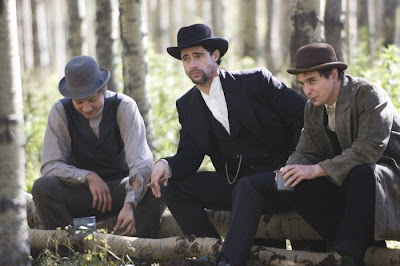
My favourite film: The Assassination of Jesse James by the Coward Robert Ford


What's to like about The Assassination of Jesse James by the Coward Robert Ford? Well, many things if you can get past the title. When asked what my favourite film is my response is often one which leaves people unfamiliar with the film either dumbfounded or under the impression that my taste is pretentious, I can see why as it's a simple enough question yet my reply can appear concieted. The film's title was written into Brad Pitt's contract when he signed on, he had it included because if the studios were to try and change the name (which they did) he'd exit the project. They knew it was financial ruin, he didn't care, and neither do I.

So, what do I like about this film so much? For a start you could watch the film on mute and still have one of the best 3hrs of your life; Roger Deakins' photography is utter perfection with each shot he and director Andrew Dominik constructed worthy of being framed and shown off anywhere. Both studied rare photos from the time period and made the conscious decision to accurately recreate America at this time rather than dress it up as a 'western', the Hollywood rendition of the old west, after all it had aesthetically more in common with Victorian England than anything we're used to seeing in films. The performances are outstanding, never missing a beat and ranging a spectrum of emotions. By the end each character has felt real, like you knew them slightly, or at least only understanding them. Nick Cave and Warren Ellis have written some of the finest music ever put to film, music that like the story of betrayal, obsession and myth that it covers, stays with you and haunts you leaving you cold when you think about it upon chance.

[What does Jesse keep seeing? His own death?]

The story of Jesse James is timeless, adapted from Ron Hansen's novel of the same name it is a story that allegorically speaks in spades according to the multimedia celebrity circus we live in today. Jesse James has become more than a man, he has become myth, a legend. He has transcended morality by living forever through the myth that he in part created but inevitably couldn't control. This is highlighted immediately within the film's opening shots aided by an omniscient narrator; the narrator speaks of the Jesse James myth and rumours taken from 'witnesses' of his actions, what is said off screen by the narrator is contradicted on screen by Jesse himself; in a simple but effective moment Jesse (Brad Pitt) stands alone in a field, the narrator speaks that Jesse has a condition know as "granulated eyelids" which causes him to blink more than usual "as if he found creation slightly more than he could accept", while we are hearing this information what we see is Jesse staring morosely into nothingness for an extended period of time without blinking, a melancholic stare that comes accustomed to Jesse as the film goes on. Of course what these openings moments show is that no one knows the real Jesse despite his celebrity claiming to know everything about him, Jesse the myth and Jesse the man are separate entities and who better than Brad Pitt of all actors to convey this parable to us.


The story of course works as a retelling of Judas's betrayal of Jesus, a betrayal that Jesus knew was coming. Throughout this story we get the feeling from Jesse (like Jesus) that he sees his own death before him, the moroseness of his character the long stares into nothingness and of course the ambiguous confusing moments of his murder. Did Jesse always know that Bob would kill him? How and also when he would die? These questions proposed by the film majorly adds to what makes it so thoroughly haunting. The film starts off with a meal between Jesse and his men before they embark on their last heist together, they are like Jesus and his disciples eating in the last supper at the end of their days with a traitor amongst them. Unlike classic rise and fall films The Assassination of Jesse James focuses entirely on the fall and the last days of the James clan after years of crime. After their last job the clan disbands save a few and that's where we are dropped off in the story.

This last mission that Jesse and his men undergo is the robbery of a train; the scene is one of the most beautifully filmed sequences one will ever see and the image of Jesse standing on the tracks awaiting the train in the fog while the other men's masked faces are lit by firelight is the one that stays with you above all.

[A shot to remember]

One might think that Brad Pitt steals the show or at least most of the screen time in this one but that isn't so. Has Brad Pitt ever been better? Probably not, but in a film that boasts a cast of thespians such as Casey Affleck, Sam Rockwell, Jeremy Renner, and Garret Dillahunt he was never going to be the soul focus despite his character's status. It really is Bob Ford's story here and Casey Affleck produces a performance so detailed and nuanced, so highly strung and note perfect that the film rests on him and excels because of it. Sam Rockwell takes a slight back seat as Bob's older brother Charley but steals the film every chance he gets in a performance riddled with shame and guilt at the Ford brother's actions and subsequent fame.

As mentioned before, celebrity is at the heart of this story, like Andrew Dominik's previous film Chopper it showcases the power and damage it can hold over an individual and a society. The simple warning is how dangerous it can be to meet your hero, in Bob's case a hero he has idolised to a point of derangement. Upon meeting Jesse, Bob soon realises he is not the great man he grew up reading about in serials, he is a disappointment and so his adoration for him slowly turns to resentment. Despite Bob Ford being a desperate and unhinged character who can only be seen as out for himself, Affleck manages to give us enough to like by giving him a child like innocence that has been tainted somehow, a 20 year old boy trying to be a man marking the world any way he can. The character of Bob is at first easy to detest but even by the end, his life and what has become of him still makes me sad because at the centre of this confused and desperate man was someone who wanted to be loved and taken seriously and for all his efforts and for his sins he was still ridiculed and hated no matter how hard he tried. A tragically pathetic life.


This film has a dreamlike ephemeral quality to it that can not be shaken off, a beauty to it but also great tragedy. For all the films' power and its haunting menace it also offers moments that are delicate and humorous; the opening campfire scene with the James clan is filled with conversations so brilliantly realised you'd think you were eaves dropping on the past, Dick Liddil spouting poetry to an amazed Ed Miller after telling him that poetry is the way to a women's heart and that Ed's one time prostitute did not love him. The constant teasing throughout the film of Bob by Charley feels genuinely heartfelt and brotherly, and Bob's recital at the dinner table of why he and Jesse are so similar is painfully worrying but also strangely hypnotic. It is for these moments that I'm proud to call The Assassination of Jesse James by the Coward Robert Ford my favourite film, just don't let the title put you off!

Wednesday, 31 August 2011

The Tree of Life (Terrence Malick, 2011)


There is only one Terrence Malick in this world and for his cinematic output we should be extremely grateful. Not that his output shares anywhere near the numbers of prolific peers such as Francis Coppola, Martin Scorsese or Woody Allen; Since 1973 when Malick released his debut feature Badlands up until the release of his newest film The Tree of Life he has only directed five films. However, what he lacks in quantity he makes up for in quality, a unique quality that sets him apart from any other filmmaker ever to have lived and one that divides audiences right down the middle. His films aren't necessarily hard to digest, they just aren't for everyone; over the years Malick's style has remained consistent yet constantly developing and evolving, taking aspects of his visual style, themes, and obsessions and pushing them to the limits while focussing less and less with a pushing narrative.

In his debut film Badlands (1973) we saw his fictionalised account of the notorious Starkweather-Fugate killing spree that took place during South America in the 1950s. His next film Days of Heaven (1978) focussed on the fall of grace between a chronically ill farmer and his two workers while caught in a love triangle. It would be twenty years before Malick would complete work on his third feature The Thin Red Line (1998) a World War II film based on the autobiographical novel by James Jones, it was at this point in his career that the true essence of his style had come to fruition; The wandering narrative picking up with one character one minute then dropping them and picking up with another without any introduction, long lingering shots of nature whether it be a wide shot of trees bending, a close-up of a snail crawling, or native children playing. It was also at this point in Malick's career where as a fan you either had abandoned him or stepped over the edge with him. His next film, 2005's The New World further cemented Malick's sensibilities as a filmmaker even further, again like his previous outing this film was a wondering meditative poem to cinema that although follows the troubles between the native Americans and the English settlers during the 17th century, seemed more hung up on the relationship between man and nature once again. Like his war film the action sequences are beautifully but tragically filmed from a God's eye point of view that reminds us of the complicated evil humans are capable of whilst surrounded by the simple sereneness of nature.

This slight overview of Malick's career is importantly referenced when talking about his new release The Tree of Life as it sees the auteur director pushing perhaps even his most loyal follows to their limits.


Like Badlands this new story (if you can call it a story) takes place in the 1950s, it follows a family of two boys brought up by a stern world worn father (Brad Pitt) and an angelic idealistic mother who seems to be and is literally shown to be at one with nature at times. We learn at the beginning that one of the sons has been killed, how?, we never learn but we suspect Vietnam, from then on we follow the remaining son Jack as an adult (played by Sean Penn) and as a young boy (Hunter McCracken). The loose narrative is fragmented and the editing is brutal, there must be more jump cuts present than Godard could even dream of; one moment adult Jack is working in what seems to be an extremely high end job (architect?), then we cut back to Jack as a boy playing in the garden with his brother, going to church, being told off or hit by his father. Then we are thrown back into Jack's adult life minutes later where he wanders aimlessly through streets with no direction. If all this wasn't enough to take in, Malick pulls us out of the intimate 1950s family life when we have just got settled in and takes us back to the dawn of time, yes that's right, nothingness. This segment lasts 20 minutes and slowly but surely we see the world being made, as atoms collide into other atoms we finally arrive at something that resembles a liveable habitat, then after that cells collide with other cells and organs grow and limbs and lungs are built we see the creation of sea creatures and eventually land dwellers. These creatures eventually become dinosaurs and Malick follows them around while we feel more and more like we're watching a BBC production, then in the blink of an eye we are back to being thrown around between the events of Jack's life once again.


While this all sounds ridiculous and like too much hard work the film for all its innovations and gutsy decisions has a simple agenda at its core. Malick's camera once again roams around as if hoping once again that he will capture God on film, that he will see both God and nature as one. In following Jack's young life we see how he is torn between his upbringing; his father is deeply rooted in the ways of the cruel modern world but his mother remains rooted in the simplicity and serenity of nature, these factors conflict inside him and end up as burdens he carries into adult life. As a man Jack has become part of the corporate world, a world that has lost touch and so therefore he has lost touch. How do we place ourselves on Earth and maintain a purpose when we are no longer part of it?


As much as The Tree of Life offers no answers it gives us the chance to think about life's many questions and helps us to confront our disillusions with the modern world and where we come into the equation. The daring creation sequence that the film fearlessly shows might feel jarring and perhaps unnecessary to some but its purpose is important to remind us that the problems we face no matter how big they feel in proportion to our everyday day hum drum lives are not important when you take a step back. Malick gives us the chance to step back; as the opening Biblical quote from Job 38:4 declares, God said unto Job, "Where were you when I laid the earth's foundation? Tell me, if you understand".

Some are saying that Malick has gone too far this time (not that this kind of statement gets thrown at him very often) and others are declaring The Tree of Life a milestone of cinema on the same level as Kubrick's 2001. What side of this verdict you'll fall into will depend on how much you're willing to invest in what can easily be called the most beautifully profound film ever made. You get out of it what you put in to it, it's all up to you.