Showing posts with label Western. Show all posts

Wednesday, 23 January 2013

Django Unchained (2012, Quentin Tarantino)


Some old problems still remain in the creaky cinematic machine that is Quentin Tarantino, but his first full foray into the Western genre after years of pseudo efforts has produced his most rewarding and focussed film in 15years.

Following the titular character; a freed slave (Jamie Foxx) is liberated at the hands of a German dentist turned bounty hunter (Christoph Waltz). We follow the duo as they bond in a partnership to at first take down a trio of slaving brothers before moving on to save Django's wife, Broomhilda (Kerry Washington), who still remains captive in the dark heart of Mississippi.

Foxx is largely reticent for the most part, a brooding presence with a singular motive to track down his beloved wife but lacking the wit and wherewithal to do so successfully. Waltz's Dr. King Schultz plays on the chemistry from his Oscar-winning turn in Tarantino's Inglourious Basterds; a diplomatic exterior acting as smokescreen to latent violence. Though his performance here is much more complex as an acting hero of sorts but also a stranger in a strange land where slavery and the sadistic mistreatment of African slaves is habitual. It's hard to decipher how much Schultz understands of his surroundings at first as his insubordination borders on the naive at times. For instance, when he takes Django for a drink in a local saloon to explain how Django can help him track the Brittle brothers, the owner tells him Django isn't welcome to which Schultz forces him to fetch the Sheriff leading to a standoff. This seeming act of defiance gives way to a secondary motive later on but whether Shultz wholeheartedly understands the deep-set racism at this point is doubtful as his further journey south sees the calm killer become mentally dishevelled by the horrors witnessed.

The first hour sees Django learning new skills and the ways of bounty hunting, earning the money that will make his mission to Mississippi possible. A 'buddy movie' scenario arises as the two form a deadly team while Schulz becomes increasingly attached to the man whose freedom he now feels responsible for. The doctor forms a rather complex plan for a facade in which the two pose as Mandingo traders - the profession of slave fighting -  in a bid to get the "attention" of Broomhilda's wealthy plantation owner Calvin Candie played by Leonardo DiCaprio. It's upon their arrival in Candie's county and eventually his household that the film descends into a nightmare game of wits and a further exploration into the echelons of human depravation.

Django Unchained features some of the most fluid directing of recent Tarantino; whereas his Inglourious Basterds had moments of brilliance it also felt flat and smothered, the pieces didn't slot together, failing to ignite the spark. Save a few misjudged moments the pieces do indeed meld together this time, most notably the flashbacks and musical cues while the gimmicky and stifling nature of Tarantino's chapter format is gladly absent. Director of Photography Robert Richardson also executes some of his best work here which is stunning throughout every frame, delivering images and sequences that stick vividly in the mind. Tarantino has been guilty of overloading his films of late, something that's bewildering to me as he's in such a comfortable financial standpoint but has constructed his films like each could be his last, offering an extraneous amount of ideas and characters thus losing sight as his stories 'develop'. It's refreshing then to have a real journey on our hands this time, yes there are many popups from new and old talents; Jonah Hill has his moment as an early clansman while veteran Don Johnson has fun with his sickly slave owner role. Though as we meet our titular hero in the opening credit sequence who in turn meets with his future partner shortly after, we stick to both Django and Shultz throughout and the men at the end of the film are far from the men who were destined to meet in the beginning.

Leonardo DiCaprio delivers a devilish performance as Calvin Candie, the proprietor of the ill-named 'Candieland'. His role is far from the overbearing evil that could so easily be imagined; Candie is a  spoilt young man of privilege, a product of his wealth and upbringing. He is king in his own castle in a country that condones his barbaric treaty, this is a world where flesh is property. Tarantino takes things into even murkier territory with the arrival of House Master and right hand man Stephen, played by Samuel L. Jackson at the height of his talents. Possibly the most heinous role a black actor could embark on, Stephen isn't just loyal to his master but is an extension of his mentality. Jackson has perhaps never been this impressive in a performance that like the film itself is fearless in its representation of slavery at this time.

A filmmaker as brash as Tarantino, an artist whose broad strokes are unrivalled in Hollywood was a worry to take on such delicate material as this. Django Unchained has all the hallmarks of his films; the blood-soaked shootouts, visual elements of 70s exploitation cinema, and a warped sense of humour. But for a stubbornly idiosyncratic director it's a marvel that all the elements are juggled so well. Scenes such as slaves being forced to fight to the death, being whipped, branded, set upon by dogs, are all profoundly moving and never short of respectful due to the emotional weight behind it. Then of course there's the comedy of it which stems mostly from character, Stephen's introduction is hilarious despite its damning nature, and the camaraderie between Shultz and Django is often eye watering. The film offers a wide spectrum of emotion and is in some respects exhausting, it's the longest of Tarantino's career and the first without his longtime editor Sally Menke, yet despite its great length (165mins) and the fact that Tarantino over ices his cake (once again) this still marks the most focussed of his recent efforts. Just when the film slumps into a lower gear and its forceful drive lessens into ambivalence it always manages to fling back with a powerful punch.

Tarantino's cinema has been increasingly criticised for gross indulgence, superfluousness, and in the recent case of his historic revisions, severe cases of levity. These things can certainly be thrown at Django Unchained but it's passionate and sincere despite it's creator's gung-ho, punk rock approach. I'm baffled by other critics' dismissal of Tarantino in a time of creative drought, as despite his squandering of his talents and various shortcomings here we have a fearless director who for better or for worse will not, cannot compromise. His approach to filmmaking reminds of a quote from the great Billy Wilder, in which he said "If there's anything I hate more than not being taken seriously, it's being taken too seriously". 

With his last film he took on history by way of World War Two and delivered a film with a singular crime of staleness. With Django Unchained, a clear companion piece if there ever was one, Tarantino was always going to ruffle some feathers but here he succeeds in all the ways his previous film failed by being both emotionally engaging and entertaining. They don't make 'em like they used to, but then again they never made 'em like this either.

Thursday, 10 November 2011

My favourite film: The Assassination of Jesse James by the Coward Robert Ford


What's to like about The Assassination of Jesse James by the Coward Robert Ford? Well, many things if you can get past the title. When asked what my favourite film is my response is often one which leaves people unfamiliar with the film either dumbfounded or under the impression that my taste is pretentious, I can see why as it's a simple enough question yet my reply can appear concieted. The film's title was written into Brad Pitt's contract when he signed on, he had it included because if the studios were to try and change the name (which they did) he'd exit the project. They knew it was financial ruin, he didn't care, and neither do I.

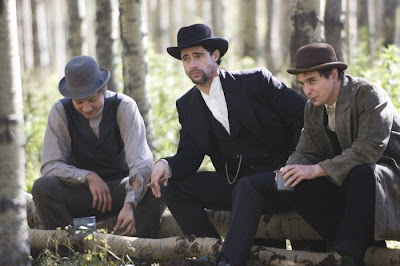
So, what do I like about this film so much? For a start you could watch the film on mute and still have one of the best 3hrs of your life; Roger Deakins' photography is utter perfection with each shot he and director Andrew Dominik constructed worthy of being framed and shown off anywhere. Both studied rare photos from the time period and made the conscious decision to accurately recreate America at this time rather than dress it up as a 'western', the Hollywood rendition of the old west, after all it had aesthetically more in common with Victorian England than anything we're used to seeing in films. The performances are outstanding, never missing a beat and ranging a spectrum of emotions. By the end each character has felt real, like you knew them slightly, or at least only understanding them. Nick Cave and Warren Ellis have written some of the finest music ever put to film, music that like the story of betrayal, obsession and myth that it covers, stays with you and haunts you leaving you cold when you think about it upon chance.

[What does Jesse keep seeing? His own death?]

The story of Jesse James is timeless, adapted from Ron Hansen's novel of the same name it is a story that allegorically speaks in spades according to the multimedia celebrity circus we live in today. Jesse James has become more than a man, he has become myth, a legend. He has transcended morality by living forever through the myth that he in part created but inevitably couldn't control. This is highlighted immediately within the film's opening shots aided by an omniscient narrator; the narrator speaks of the Jesse James myth and rumours taken from 'witnesses' of his actions, what is said off screen by the narrator is contradicted on screen by Jesse himself; in a simple but effective moment Jesse (Brad Pitt) stands alone in a field, the narrator speaks that Jesse has a condition know as "granulated eyelids" which causes him to blink more than usual "as if he found creation slightly more than he could accept", while we are hearing this information what we see is Jesse staring morosely into nothingness for an extended period of time without blinking, a melancholic stare that comes accustomed to Jesse as the film goes on. Of course what these openings moments show is that no one knows the real Jesse despite his celebrity claiming to know everything about him, Jesse the myth and Jesse the man are separate entities and who better than Brad Pitt of all actors to convey this parable to us.


The story of course works as a retelling of Judas's betrayal of Jesus, a betrayal that Jesus knew was coming. Throughout this story we get the feeling from Jesse (like Jesus) that he sees his own death before him, the moroseness of his character the long stares into nothingness and of course the ambiguous confusing moments of his murder. Did Jesse always know that Bob would kill him? How and also when he would die? These questions proposed by the film majorly adds to what makes it so thoroughly haunting. The film starts off with a meal between Jesse and his men before they embark on their last heist together, they are like Jesus and his disciples eating in the last supper at the end of their days with a traitor amongst them. Unlike classic rise and fall films The Assassination of Jesse James focuses entirely on the fall and the last days of the James clan after years of crime. After their last job the clan disbands save a few and that's where we are dropped off in the story.

This last mission that Jesse and his men undergo is the robbery of a train; the scene is one of the most beautifully filmed sequences one will ever see and the image of Jesse standing on the tracks awaiting the train in the fog while the other men's masked faces are lit by firelight is the one that stays with you above all.

[A shot to remember]

One might think that Brad Pitt steals the show or at least most of the screen time in this one but that isn't so. Has Brad Pitt ever been better? Probably not, but in a film that boasts a cast of thespians such as Casey Affleck, Sam Rockwell, Jeremy Renner, and Garret Dillahunt he was never going to be the soul focus despite his character's status. It really is Bob Ford's story here and Casey Affleck produces a performance so detailed and nuanced, so highly strung and note perfect that the film rests on him and excels because of it. Sam Rockwell takes a slight back seat as Bob's older brother Charley but steals the film every chance he gets in a performance riddled with shame and guilt at the Ford brother's actions and subsequent fame.

As mentioned before, celebrity is at the heart of this story, like Andrew Dominik's previous film Chopper it showcases the power and damage it can hold over an individual and a society. The simple warning is how dangerous it can be to meet your hero, in Bob's case a hero he has idolised to a point of derangement. Upon meeting Jesse, Bob soon realises he is not the great man he grew up reading about in serials, he is a disappointment and so his adoration for him slowly turns to resentment. Despite Bob Ford being a desperate and unhinged character who can only be seen as out for himself, Affleck manages to give us enough to like by giving him a child like innocence that has been tainted somehow, a 20 year old boy trying to be a man marking the world any way he can. The character of Bob is at first easy to detest but even by the end, his life and what has become of him still makes me sad because at the centre of this confused and desperate man was someone who wanted to be loved and taken seriously and for all his efforts and for his sins he was still ridiculed and hated no matter how hard he tried. A tragically pathetic life.


This film has a dreamlike ephemeral quality to it that can not be shaken off, a beauty to it but also great tragedy. For all the films' power and its haunting menace it also offers moments that are delicate and humorous; the opening campfire scene with the James clan is filled with conversations so brilliantly realised you'd think you were eaves dropping on the past, Dick Liddil spouting poetry to an amazed Ed Miller after telling him that poetry is the way to a women's heart and that Ed's one time prostitute did not love him. The constant teasing throughout the film of Bob by Charley feels genuinely heartfelt and brotherly, and Bob's recital at the dinner table of why he and Jesse are so similar is painfully worrying but also strangely hypnotic. It is for these moments that I'm proud to call The Assassination of Jesse James by the Coward Robert Ford my favourite film, just don't let the title put you off!