Showing posts with label Andrew Dominik. Show all posts

Thursday, 27 September 2012

Killing Them Softly (2012, Andrew Dominik)


George V. Higgins' 1974 pulp-crime novel Cogan's Trade gets a modern revamping with an intensified sociopolitical twist in Andrew Dominik's newly titled Killing Them Softly. Though the underlying themes of this microcosmic tale of retribution are often as on-the-nose as some of the harsh hits throughout, with its ambitions fully realised and the help of an outsider's eye it transcends its genre trappings making one of the most aspiring crime pictures in many years.

An ex-con hires two younger men to hit a mob-protected poker game after second guessing the direction of the mob's counterblow, an outcome that will go in the three's favour as they leave clean with $50,000. In steps Jackie Cogan (Brad Pitt) also hired, this time by the mob to find those responsible for the robbery. Jackie is an intriguing kind of enforcer, an intermediator of both political and financial wellbeing playing off public (street) perception to see that business carries on as usual without truth disrupting commerce.

Killing Them Softly certainly concerns itself with contemporary politics, the current economic climate, and the ramifications on the business sector; organised crime is presented candidly here as a delicate business also under the strain of the recession. It is, after all, a trade like any other and despite the gun welding personnel of the involved, their finances are not bulletproof either. Writer/director Andrew Dominik has stated that he has always viewed crime films as a representation of capitalism, that no other genre acceptably features central characters selfishly crusading for personal gain. Dominik's point might seem patent at first but is entirely accurate, especially as he takes this underlying theme and pushes it to the forefront be be examined and exerted in his film, making an airtight case. The results are severe in both execution and effect, with Obama's (then campaigning for presidency) speeches providing regular commentary on the desperate acts of violence displayed throughout the film.

The film is hardly homework, though, requiring not even a basic knowledge of current political happenings to enjoy. Filling in for the overly simple plot is an incredible array of characters expertly played by a note perfect ensemble; Ben Mendelsohn (Animal Kingdom) and Scoot McNairy (Monsters) are wonderful as the depraved duo who hold up the poker game, their bumbling and sophomoric sensibilities providing the majority of the film's laughs. While James Gandolfini steals the show with a short appearance as Jackie's old friend, flown in to take care of an organised hit. Though staggeringly funny at times, his Mickey is a broken man whose misfortune has crippled him, figuratively speaking. His outward musings of his thin marriage and the possibility of doing more time is delivered with such heart and conviction that this unlikable man introduced for a matter of minutes becomes a tragically sympathetic character who's zest and professonality has gone down with the economy. His choice of business has destroyed him. Brad Pitt hardly leads the show but his Jackie Cogan is interesting beyond the instantly classic exterior; Jackie is capable of great violence but unlike the others likes to remain distant, often physically distant, but also away from the emotions that death can bring. Jackie comforts his prey to a degree, easing them into a false sense of security before the deathblow.

There is a sadness, a biting nihilism to the story and a desolate bleak atmosphere expertly maintained from start to finish. Dominik and director of photography Greig Fraser give Killing Them Softly a fitting end-of-the-world vibe that sticks even through the film's many successful bouts of humour. The film also includes some visually arresting moments (some effective with others falling on unnecessary) to heighten the humdrum nature of the story, especially during more violent moments where he never fails to make you flinch. It's reassuring to know that a filmmaker can still make violence uneasy to an audience. Even his off-key treatment of the opening credits stands you on edge before the first shot has even been fired.

Killing Them Softly is an unapologetic indictment of the 'American Dream', hardly new territory or much to be proud of by now. Given the almost alien representation of the America we're used to seeing through Hollywood, the film's desolate locales, the morally devoid characters, and the bitterly infused words of Brad Pitt in the film's final line, we get an uncharacteristically ambitious crime film that plans to entertain as well as backup its ideology and succeeds at doing both. Whether Killing Them Softly will gain a major audience from its food-for-thought approach to genre filmmaking, we can only hope, as this is a cut above the rest and Andrew Dominik is now going 3 for 3.

Tuesday, 18 September 2012

Director's Commentary - Chopper (2000)

Andrew Dominik's commentary track for his debut feature Chopper.


On people's objections to the film:

The film was a lot more difficult to get going than I anticipated, we met with quite a few moral objections. Many people felt it was wrong to make a film about Chopper because it in someway glorified him or held him up as a role-model, and I think the film does that but it does validate him which is kind of the point of the film, you don't make a film about someone that you despise. The other thing was that people were very uncomfortable with the film at script stage, that the film refused to judge him, which I think is it's great strength, it doesn't glorify or condemn him.

On Chopper's attack on Keithy George:

This character of Keithy George played by David Field is a fictionalised version of the person who Chopper actually tangled with in jail, this guy was a very heavy criminal but we don't set him up that way in the film. We didn't want to set Keithy George up as a bad guy because then Chopper becomes the lesser of two warring evils and we very much wanted Chopper to be responsible for his own actions so I didn't want to confuse the audience by sort of justifying Chopper's attack on Kiethy. What I'm really interested in with Chopper's attack on Keithy is the effect that it has on Chopper. Chopper actually did this, gave people advice on how to kill him and get off on self-defence, it's sort of a joke but it's true, Chopper really is hell bent on his own destruction, hell bent on creating an enemy for himself. This scene here is kind of the whole reason why I made the film, in his books Chopper portrays himself as unrepentant and proud, he's sort of proud of being this remorseless killer but there's contradictions throughout the books as well where he describes disturbing dreams where the faces of his victims come back to him, or he will apologize very directly to someone in print which suggested to me on initial reading that he had mixed feelings about the things he did. This is where the film gets really interesting for me, attack this guy in a fit of rage and then all of a sudden the fog clears and he's like a tourist in his own body, horrified by what he's done. These apologise of Chopper I think are sincere, often in these kind of pathologies in things like domestic violence where there's a cycle of abuse and remorse, very much it's the violence that's taken to be sincere and the remorse is taken to be phony but I think the two things go hand in hand. Perhaps Chopper is not feeling guilty here because he's attacked Keithy in order to feel guilt, trying to resolve some age old psychological problem for himself.

On Chopper not realising he's being stabbed by Jimmy:

I think what's being dramatised here is not so much that Chopper is invincible but that he's in a deep state of shock, which I think is realistic when something extreme like this happens to you, that the feelings follow a little bit behind. Talk to anyone who's broken a bone or had anything big psychically done to them and they'll tell you the pain doesn't happen immediately. I think what's also being dramatised here is Chopper's denial, denying the reality of what's occurring, this thing with putting his cigarette back in his pocket was something he said happened, "I'm being stabbed so I'll save my cigarette till later". He just can't accept the idea that Jimmy would betray him. This thing here with Chopper hugging Jimmy was an idea of Eric's which Simon wasn't expecting, a very strange thing to do in the middle of a stabbing, to embrace your attacker. Chopper is very philosophical about the stabbing and I think there's a couple of reasons for this, one is that he doesn't want to admit that Jimmy has betrayed him because for him to realise that makes him very much alone. The other thing is that Chopper does have a sense of sin or guilt and he knows he's done bad things so he's always expecting bad things to be done to him, some sort of retribution to come to him. He's constantly on guard for that retribution so when it finally does come he's kind of relieved, he no longer has to be frightened of being afraid of it.

On using the locations where Chopper's experiences actually happened:

We shot all these scenes in the actual locations where they occurred, which is a great thing when your shooting a scene like this, it can very easily become about camera moves and just about everything apart from what's going on in the scene. It was great when those moments happened to be able to remind everybody we were shooting this stabbing in the actual location where it took place 10 years before hand. That would always lend a certain gravity to the proceedings and snap people back to where they were supposed to be.

On Chopper driving Neville to the hospital after shooting him:

Chopper's point of view is kind of clarified in the relationship and now he's comfortable, it was the not knowing whether or not he had an enemy that he couldn't stand, now he's got his enemy and he knows what the deal is. This actually happened on two occasions that I know about where Chopper shot somebody and drove them to the hospital and then strenuously denied it. I don't think he's denying it to get away with it, he doesn't want to appear soft hearted, he wants to appear like the unrepentant killer, he's embarrassed that anyone should know about his empathy which he regards as a weakness. There's another reason that he takes Neville to the hospital, maybe below empathy, which is that he wants his enemy to survive. An enemy is necessary to his psychology in some way; since being released from jail he has all these unknown and unfocussed anxieties which if he has an enemy he can focus those anxieties on at least something he feels he can control.

The shooting of Sammy the Turk:

I think he's so wound up now there's a part of him that just wants to go back to jail. He's so overwhelmed by the world outside and the paranoia has built in him to such an extent, he hasn't been able to take it out on Jimmy because he doesn't want to so he's finding a substitute to release it on. Sammy just can't win in this conversation, even if he is innocent of setting Chopper up his innocence will just be read as lying. Like always he instantly regrets what he's done, the strange thing about Chopper is to me the character retains a kind of innocence all the way through the film because he's just not in control of himself. I think this behaviour is very childlike, this cycle of attack and regret, attack and remorse. An angry child would destroy the world if it could but you don't really hold that against them, I feel the same way about the character.

Chopper the myth:

What you see here instead of redemption for Chopper, is this kind of complete transcendence of reality where instead of facing himself he becomes his own favourite character in fiction, he rewrites history. Here we have Chopper's fan club, the people who admire him for the myth that he's reported about himself as apposed to the reality of the man. Mark himself talks about Chopper in the third person, he sees 'Chopper' as someone he's created for public consumption, something distinct from Mark the person. Now we come to Chopper revelling in his own mythology which I think is something the moral detractors of the film felt the film was going to do, that it would feed Chopper's need for attention and that this was a bad thing. I think you need to look at why a person like Chopper needs attention, attention is pretty much a fundamental human need and if it's not met in a fundamental way it doesn't just go away, I mean if you're hungry you don't get food you don't just suddenly stop being hungry. I think with Chopper maybe this need has become quite grotesque and distorted and come out in his hunger for publicity. He sort of gets public attention at the expense of any sort of private intimacy, I think the vain that he's got is for an image, for a circus performance called Chopper that has little to do with Mark the person which isolates him further, which is the great tragedy of the character. I was very obsessed with this last moment of the film, of Chopper by himself. The consequences of violence, I wanted to know what they were for the perpetrator and the answer I came up with in the process of making the film was that the consequences of violence is loneliness so it was very important to get this lonely feel at the end.

Thursday, 10 November 2011

My favourite film: The Assassination of Jesse James by the Coward Robert Ford


What's to like about The Assassination of Jesse James by the Coward Robert Ford? Well, many things if you can get past the title. When asked what my favourite film is my response is often one which leaves people unfamiliar with the film either dumbfounded or under the impression that my taste is pretentious, I can see why as it's a simple enough question yet my reply can appear concieted. The film's title was written into Brad Pitt's contract when he signed on, he had it included because if the studios were to try and change the name (which they did) he'd exit the project. They knew it was financial ruin, he didn't care, and neither do I.

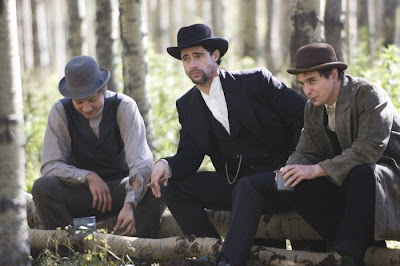
So, what do I like about this film so much? For a start you could watch the film on mute and still have one of the best 3hrs of your life; Roger Deakins' photography is utter perfection with each shot he and director Andrew Dominik constructed worthy of being framed and shown off anywhere. Both studied rare photos from the time period and made the conscious decision to accurately recreate America at this time rather than dress it up as a 'western', the Hollywood rendition of the old west, after all it had aesthetically more in common with Victorian England than anything we're used to seeing in films. The performances are outstanding, never missing a beat and ranging a spectrum of emotions. By the end each character has felt real, like you knew them slightly, or at least only understanding them. Nick Cave and Warren Ellis have written some of the finest music ever put to film, music that like the story of betrayal, obsession and myth that it covers, stays with you and haunts you leaving you cold when you think about it upon chance.

[What does Jesse keep seeing? His own death?]

The story of Jesse James is timeless, adapted from Ron Hansen's novel of the same name it is a story that allegorically speaks in spades according to the multimedia celebrity circus we live in today. Jesse James has become more than a man, he has become myth, a legend. He has transcended morality by living forever through the myth that he in part created but inevitably couldn't control. This is highlighted immediately within the film's opening shots aided by an omniscient narrator; the narrator speaks of the Jesse James myth and rumours taken from 'witnesses' of his actions, what is said off screen by the narrator is contradicted on screen by Jesse himself; in a simple but effective moment Jesse (Brad Pitt) stands alone in a field, the narrator speaks that Jesse has a condition know as "granulated eyelids" which causes him to blink more than usual "as if he found creation slightly more than he could accept", while we are hearing this information what we see is Jesse staring morosely into nothingness for an extended period of time without blinking, a melancholic stare that comes accustomed to Jesse as the film goes on. Of course what these openings moments show is that no one knows the real Jesse despite his celebrity claiming to know everything about him, Jesse the myth and Jesse the man are separate entities and who better than Brad Pitt of all actors to convey this parable to us.


The story of course works as a retelling of Judas's betrayal of Jesus, a betrayal that Jesus knew was coming. Throughout this story we get the feeling from Jesse (like Jesus) that he sees his own death before him, the moroseness of his character the long stares into nothingness and of course the ambiguous confusing moments of his murder. Did Jesse always know that Bob would kill him? How and also when he would die? These questions proposed by the film majorly adds to what makes it so thoroughly haunting. The film starts off with a meal between Jesse and his men before they embark on their last heist together, they are like Jesus and his disciples eating in the last supper at the end of their days with a traitor amongst them. Unlike classic rise and fall films The Assassination of Jesse James focuses entirely on the fall and the last days of the James clan after years of crime. After their last job the clan disbands save a few and that's where we are dropped off in the story.

This last mission that Jesse and his men undergo is the robbery of a train; the scene is one of the most beautifully filmed sequences one will ever see and the image of Jesse standing on the tracks awaiting the train in the fog while the other men's masked faces are lit by firelight is the one that stays with you above all.

[A shot to remember]

One might think that Brad Pitt steals the show or at least most of the screen time in this one but that isn't so. Has Brad Pitt ever been better? Probably not, but in a film that boasts a cast of thespians such as Casey Affleck, Sam Rockwell, Jeremy Renner, and Garret Dillahunt he was never going to be the soul focus despite his character's status. It really is Bob Ford's story here and Casey Affleck produces a performance so detailed and nuanced, so highly strung and note perfect that the film rests on him and excels because of it. Sam Rockwell takes a slight back seat as Bob's older brother Charley but steals the film every chance he gets in a performance riddled with shame and guilt at the Ford brother's actions and subsequent fame.

As mentioned before, celebrity is at the heart of this story, like Andrew Dominik's previous film Chopper it showcases the power and damage it can hold over an individual and a society. The simple warning is how dangerous it can be to meet your hero, in Bob's case a hero he has idolised to a point of derangement. Upon meeting Jesse, Bob soon realises he is not the great man he grew up reading about in serials, he is a disappointment and so his adoration for him slowly turns to resentment. Despite Bob Ford being a desperate and unhinged character who can only be seen as out for himself, Affleck manages to give us enough to like by giving him a child like innocence that has been tainted somehow, a 20 year old boy trying to be a man marking the world any way he can. The character of Bob is at first easy to detest but even by the end, his life and what has become of him still makes me sad because at the centre of this confused and desperate man was someone who wanted to be loved and taken seriously and for all his efforts and for his sins he was still ridiculed and hated no matter how hard he tried. A tragically pathetic life.


This film has a dreamlike ephemeral quality to it that can not be shaken off, a beauty to it but also great tragedy. For all the films' power and its haunting menace it also offers moments that are delicate and humorous; the opening campfire scene with the James clan is filled with conversations so brilliantly realised you'd think you were eaves dropping on the past, Dick Liddil spouting poetry to an amazed Ed Miller after telling him that poetry is the way to a women's heart and that Ed's one time prostitute did not love him. The constant teasing throughout the film of Bob by Charley feels genuinely heartfelt and brotherly, and Bob's recital at the dinner table of why he and Jesse are so similar is painfully worrying but also strangely hypnotic. It is for these moments that I'm proud to call The Assassination of Jesse James by the Coward Robert Ford my favourite film, just don't let the title put you off!