Showing posts with label film review. Show all posts

Wednesday, 28 January 2015

Foxcatcher (2014, Bennett Miller)


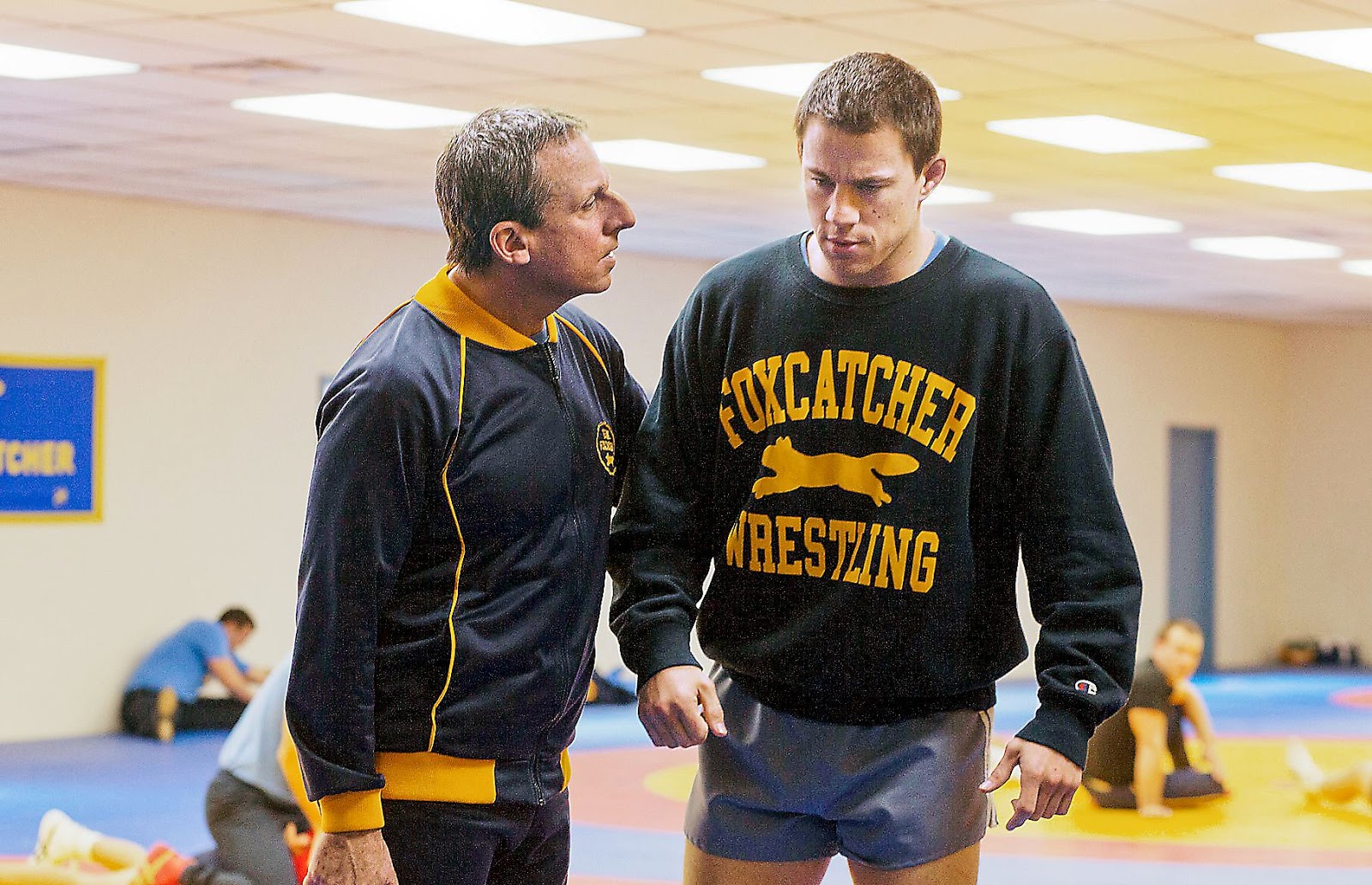
Hulking bodies and broken psyches drive Foxcatcher, Bennett Miller's fourth film and fourth based on a true event.  This is an unrelenting American horror story in which misplaced longings build to unbearable levels, giving way to upmost tragedy.

Combining the cold blooded nature of the killings centred upon in 2005's Capote and the sporting world of his last film - Moneyball -  Foxcatcher tells the torturous relationship between self-appointed wrestling coach John DuPont and the talented Schultz brothers who he came to manage. Manage, not by talent but through sheer wealth and an illogical determination to mend his once great but now flailing country to make it prosperous and proud once again. 

DuPont means to do so by training a team of talented young wrestlers to compete and win the 1988 Seoul Olympics. This team would be headed by star player Mark Shultz who won Olympic gold in '84 who after had been thrown on the junk pile. Shultz, played here by Channing Tatum, is a towering neanderthal like man with a pronounced lower jaw, hunched shoulders, and hanging arms. There's a big heart to match his other large muscles here but he's a broken childlike man looking for a place in the world. Introduced by making ends meat, Mark attends schools to motivate youngsters with his accomplishments, being paid small cash to do so, then returning to his grim lodgings to eat packeted noodles -  hardly the food of champions. One day, like a scene out of some classic noir, he receives a mysterious phone call beckoning him to the DuPont residence where he's offered his place in team Foxcatcher. Coaxed by the words of patriotism by John DuPont in person, Mark inevitably succumbs. 

Unlike his younger brother, David Schultz (Mark Ruffalo) isn't as impressed and decides to decline despite the teaming of the two brothers being what DuPont really desires. It's here that the brother's nomadic upbringing comes into the picture as from an ever moving broken home, David has settled with a family and has used this to overcome his childhood while Mark is still living it, remaining tortured by its lack of parental figures and roots. This also reveals the gravitational pull of DuPont's influence on Mark as he's week, looking for a purpose and love beyond his brother.

Steve Carell is almost unrecognisable as John DuPont and against the golden boy wrestler he's the antithesis of a man built for such a sport: he's meagre and bird like in appearance, as if his bones would shatter like glass. He speaks in broken sentences that only hint at the broken man behind the words. It's a remarkable performance, like an amalgamation of Travis Bickle and The Simpsons' Mr. Burns, and like Tatum is a performance largely built around physical idiosyncrasies that would be too easy to fall into caricature but feel truly lived in by these actors.

It's mostly in the silence of the film that Bennett and his actors allow for the story to develop. Take for instance the first time we see the Schultz brothers training together, which is also the first time they share the screen; it's one of the film's opening scenes and in it Ruffalo and Tatum convey such a wide spectrum of emotions that you realise early on you're in the company of a team of filmmakers at the top of their game.

Too call Foxcatcher a film about wrestling would be accurate as long as you were referring to the wrestling of demons throughout. Ultimately this is what E. Max Frye and Dan Futterman's screenplay boils down to - an exploration of the collateral damage from such demons with the innocent suffering the largest casualties. DuPont's choice of wrestling in the first place is odd given his naturally fragile demeanour and being the future of an elite American dynasty, as his mother (a wheelchair-bound Vanessa Redgrave) refers to the sport as below her son in one of many examples her looking upon her only offspring in a mixed look of icy bafflement and disappointment. This venture into the world of wresting makes sense when looking at it as a defying gesture to a controlling matriarch, however the homosexual subtext that the film has garnered thus far seems misplaced. While it's true there are moments of uncomfortable master/slave like power shifts between John and Mark (Hitchcock's Marnie came to mind several times) this is a film, I believe, that explores DuPont's venture as one seeking intimacy of any kind and not the sexual variety. By using the same means that destroyed his childhood, DuPont uses wealth to get what he wants and buys players for his games instead of developing any kind of interpersonal skills and relationships. From a man who found out at the age of 16 that his best friend had been paid all along for his services, this tragically maladjusted millionaire uses the sport as a means to be close to others, whether that be on the mat individually or part of a team. The most striking example showing DuPont administering the same parental behaviour that corrupted him in the first place is best shown comparing two scenes that lodge in the memory. The first is a beautifully shot sequence in which John releases his mother's horses from their stables soon after her passing; a moment of simple subtext as a son lets go of his emotional baggage except we soon learn that letting go for John is impossible as he's cursed to being consumed by it instead. The second scene contain a simple framing of Mark as he's visited by brother David in his outhouse located on Foxcatcher Farm; Mark is framed in his doorway -  a stable door in which the top section is opened so he can converse with his brother, his hulking top half sticking out indeed like that of a horse. Kept on the farm like the other wrestlers, DuPont merely collects people like his mother's precious horses and like the many antiques of the main house. Kept for their function and aesthetic purpose but stored either at a distance or on display. His view of human companionship beyond this purpose is alien to him.

Foxcatcher appears overly loose and meandering at times and on reflection could be argued to needing tighting - however this is also the film's key to power as the taunting and misdirection almost cancels out the suspension (though never the tension) before hitting a deathblow. Unlike those in Foxcatcher Farm who failed to notice the warning signs, we the audience have foresight into the tragedy unfolding before our eyes and  the signposted deterioration of DuPont as he grows increasingly detached and erratic. His love of guns becomes unruly and his day-to-day demeanour more subdued perhaps by his cocktail of drugs along with his eroding psyche.

Like his Capote, Bennett Miller has a real knack for creating an atmosphere of dread and manages to give his films a quality in which you're taken back to these moments, no matter how mundane or painful they are, there's a sheen to his biopics and yet they're beautifully balanced with the candid. Foxcatcher sees Bennett go three for three in his feature films so far and while it's a draining and bleak venture this time,  it's becoming somewhat of a joy to see this filmmaker's take on seismic moments of American history, even as each subject appears more esoteric than the last.

Thursday, 1 May 2014

Calvary (2014, John Michael McDonagh)


John Michael McDonagh's Calvary is a mixed bag of ideas and executions; on one hand it's a higher reaching and higher serving film than 2011's The Guard yet the simple pleasures of its predecessor are lost here in a conflicting battle of existentialism and broad humour.

At one point Brendan Gleeson's priest - Father James Lavelle - says to another offended priest, "you just don't have integrity, that's the worst thing you could say to someone". Integrity is certainly something McDonagh and his brother Martin don't lack but here is an example of a filmmaker trying to have his cake and eat it. We know the brothers' penchant for the crass, but they're also capable of great pathos (most expertly shown in Martin McDonagh's In Bruges). To quote another famous priest - Robert Mitchum's Robert Powell in The Night Of The Hunter -  is a clear battle of "right-hand-left-hand". On one hand is the introspective, brooding cinema of Ingmar Bergman, the transcendental formalism of Robert Bresson, and the equally formalist Carl Theodor Dreyer. On the other is an onslaught of obvious humour that offsets this drama asking what it means to be a priest today and what place God has in modern society.

Brendan Gleeson carries the film as effortlessly as one would expect. He makes Father James instantly recognisable and gruff, a man generally liked by the community and yet ostracised for his collar. His recovering daughter (Kelly Reilly) comes to stay with her family in this small Irish community as she gets over an attempted suicide. We never see the arrangement of her staying yet she is embraced with the calmness you might not expect from a father who's nearly lost his only child; we later find out they have lost their wife and mother, respectfully, in the past. Loss has permeated both their lives in different ways and so when death hangs above them they remain neutral as if in the company of a strange local in a dark pub. There's something beautifully serene and yet unsettling about this.

It's accurate to say that Calvary begins and ends with its most powerful and poignant scenes; the opening - a shocking confessional filmed with Gleeson in tight close up - is a straight faced and threatening scene as a formerly clergy abused child now adult vows that the Father will die in 7 days. The Guard had a sense of an impending showdown yet here the tone here is increasingly grave from the offset. The closing scene is a profound sweep over the lives of the film's players and their problems brought forward by the unfurling drama that shows the necessary impact of someone like Father James, believer or not. 

Calvary ends up being two films trying to operate simultaneously and never really gelling. The comedy even when on target (it's not always) feels more like comic relief for the films larger overarching themes. On one hand it brings to mind Bergman's Winter Light and of Bresson's Diary Of A Country Priest - yet the drama omitted form these clear reference points are diluted and off-set by the periodic crass humour, never really allowing the film to fully consider its comedy or more importantly its questions of faith and its placement in the world today.

Out of the two films it tries to be, the one that works really works. John Michael McDonagh has followed in his brother's footsteps in that he's made a rather conflicted second feature, however unlike his brother there are elements within this follow up that take this beyond his debut. Some more direction might be needed for his third feature as the talent up on screen is undoubtable, though hopefully next time making a film with a clear path instead of making two films concurrently. 

Noah (2014, Darren Aronofsky)


The Western genre is generally seen as the most 'out of date' or 'wavering' genre - a consistently unfair viewpoint as each decade harbours enough examples of such a film often complete with progressive artistry. The western as a maintaining populist genre? No, but relevant none the less. The Biblical epic, however, certainly can't be professed as such things at all. Interesting is the room in this sub-genre for reinvention on such a sweeping, fantastical stage. Even more interesting or rather baffling (for positive reasons none the less) is that this $180 million film exists in an arguably increasingly secular society where forwarding technology and social mores are suffocating artistic freedom in cinema.

Awe inspiring in its beauty and bare brutality, Noah is a cinematic experience unlike any other. At times a marvel and at others confounding in its ambition, Darren Aronofsky's long gestating take on the Old Testament's parable of a man missioned by God to undertake his destroying of creation doesn't hang together as a whole but holds within it sequences of sheer astonishment. Some of the most beautiful sequences of film to contest any example before it.

Beginning with a thumping musical introduction that's almost comical with intimidation, the story of Man's fall is glided through with the first murder of Abel by brother Caine. More fleeting is the murder of a young Noah's father, also by Caine (Ray Winstone), that begins an intertwining battle between the fallen brother and an adult Noah (Russell Crowe). Given the short nature of the source material - the story of Noah is a mere four paragraphs - Aronofsky and his team have endless room for artistic licence in bringing the pre-flood Earth to life. Characterisation is at a minimum with the film feeling very much like an adaptation of a parable (Noah is simple described as "righteous" in scripture without further divulgence) and so the players of the film exist more as archetypal figures than fully drawn ones. This certainly adds to the often direct style of acting brought by both Crowe and Winstone, however when the film reaches for higher emotional notes others, such as the brilliant Jennifer Connelly as Noah's dedicated wife feel out of sorts with the film, of course not to their own detriment.

The world building and visuals are without doubt the strongest element of Noah, with this desolate landscape coming somewhere between Middle Earth and science fiction - think Game Of Thrones by way of David Lynch's Dune. Angels cast down by God are consumed by the Earth and live tortured existence as hobbling rock creatures, these fallen rock angels help defend Noah and his family in the Ark against the sinful army of Caine. This is one of the wild moves in the film that have to be seen to be believed.

There is a certain elliptical style to the film that doesn't lend itself to the gruelling, cumbersome challenge of building an Ark of such grandeur. Aronosky's central characters have nearly always been characterised by an achilles heel, an ambition that pushes past the realm of the physical that enters them in the arena of impossibly realised dreams. Here is the first time that through divine intervention (God is referred to as The Creator throughout) the impossible can and is achieved. It's in the psychological despair, or rather guilt, of mass genocide and of this chosen family's survival that the film's dramatic arc (sorry!) hangs on and it does so well with a paranoia bringing to mind early Polanski.

Noah's apocalyptic visions are fantastically realised as he drowns in his sleep surrounded by the souls of a thousand 'sinners'. But it's in the waking reality of these visions as they come to life before him that truly strike a chord; such as the harrowing screams of those clung to rock faces just outside of the floating vessel, Noah's family know they could help save some one but their father dismisses any such action. He knows what he's been destined to carry out and Crowe's wearing eyes project the torment.

Aronofsky's films have always had a weakness in how direct and undiluted they are, yet this dually has also marked his main strength as a filmmaker too; honing in on a theme and intensely gripping it without losing sight. This has made for a career of brash and rather blunt films made majestically operatic thanks to a long lasting collaboration with composer Clint Mansell. One must never forget that despite his subjective viewpoints and often surreal nature, Aronofky is a director of melodramas. Here, Aronofsky and his team have settled on an ecological message that sits well against a parable of destruction and mankind's inability to change. This clear righteous message may frustrate many viewers more than the fears of a religious story; Noah certainly has strong explorations of faith, especially during the film's strongest sequence aboard the arc where the family fall apart due to Noah's unwavering loyalty to what he believes his mission is. Overall it is undoubtably the work of a team of non-believers but also the work of someone clearly passionate about a timeless, boundless, story that has found its way into just about any culture on the face of the planet.

Noah is hindered by being bookended with its weakest scenes and the regularly visceral Aronofsky is obviously working in 'safer' territory than before given the source material and the biggest budget of his career. This results in a slightly awkward film that although never shying away from the inherent darkness of such a story, never quite feels like it can let loose despite the sheer levels of ambition and vision on display. It's a miracle this film exists.

Sunday, 23 March 2014

The Grand Budapest Hotel (2014, Wes Anderson)


Wes Anderson's film have nearly always harboured in them a sad sense of loss, a melancholic glance at an enterprise and/or person fallen from great heights and majesty. Just think of the departed mothers and fathers of Rushmore and The Darjeeling Limited, the flailing dynasty of The Royal Tenenbaums, and Steve Zissou tragically looking to regain past glories, literally cast out in a sea of bereavement. Anderson's latest further looks into these themes while divulging once again the director's fascination with the art of storytelling, entering further into his own painfully designed fantasy world perhaps more than ever before. 

Spanning many decades but largely told over the span of two fictional versions of the First and Second World Wars, the story centres around the fine Grand Budapest Hotel and its concierge - Mr. Gustav H - played by Ralph Fiennes on barnstorming comical form. The happenings of the once legendary hotel and its passionately loving high servant is told from the aged eyes of Mr. Zero Moustafa, once a young lobby boy trained under the scrutinous command of Gustav. But that's not all, as even the frail Moustafa's account of his youth is recounted by a young writer (Jude Law) who goes on to publish a book on these memoirs. The film opens with the older author (Tom Wilkinson) reading from his praised work of the man's life he was once lucky enough to have access to. Anderson's penchant for theatrics and the joy of storytelling has never been felt more than here in this multilayered recounting of a past-era and a man whose greatness lies in the memory and heart of a once young upstart.

Mr. Gustav H is a professional at heart and in the hands of these storytellers is held up as if the greatest concierge whom ever existed; his work treated like a dance as he swans from room to room, seeing to needs before they've even arisen in the guest's minds. But he's not quite the professional one presumes from the start, he harbours a 'playful' streak that involves the seduction and obtained adoration of the hotel's various rich (and elderly) female clients. It seems innocent enough through the light nature of Gustav's charms yet this dark vice, or materialistic streak of his, is never fully explored and is merely a subjective footnote we're left to mull over.

The Grand Budapest Hotel is a strange mix of tones and it's in the marvellous use of shading that marks its biggest success. The wafer thin plotting of a will left by one of Gustav's matrons and the subsequent war waged by her enraged son goes hand-in-hand with the audacious Python-esque slapstick humour. This is counterbalanced by the cut aways to the aged Moustafa as he recounts the events, his love and loss of both his loves - Gustav and the spritely young baker, Agatha (Saoirse Ronan). Such moments are rife with mourning and become the film's most anchoring scenes that make for the heaviest moments in what from the offset could have been Anderson's lightest outing yet. The humour is pitch perfect, largely thanks Fiennes's turn in a truly inspired character such as Gustav (his effortless reciting of poetry throughout never loses its comic hold) yet this is again neutralised by the oppressive darkness brought by the murderous hitman Joplin (Willem Defoe) who's out for Gustav's blood. This brutal turn from Defoe's hitman and the swan song like recital from Moustafa are harmonised in the arrival of a Nazi-like militia that casts a shadow over the golden years told thus far. This malevolent force destroys this way of life personified by Gustav and buries it forever much like the fallen aristocracy in Visconti's The Leopard (1963).

With an ensemble cast to rival all casts assembled before it The Grand Budapest Hotel is an uneven affair due to its vast attention span but one that manages to retain a dark and sad resonance thanks to a finely built mythology weaved in throughout. And, of course, the ghost of Kumar Pallana, the Anderson regular and dear friend who was sadly lost last October who's lack of presence looms over this tale of pain and awe. 

Sunday, 26 January 2014

The Wolf Of Wall Street (2014, Martin Scorsese)


There are copious amounts of drugs consumed during The Wolf Of Wall Street. At one early point the titular Jordan Belfort (Leonardo DiCaprio) boasts of his day-to-day consumption that makes his job as a successful stockbroker possible. His everyday is a whirlwind of cursing, stress, and complete expenditure only made possible by the counteracting cocktail of drugs swooshing through his veins at all times. Of course, when he says with utter hubris of his favourite drug while snorting up a line of cocaine, he isn't speaking of the narcotic itself but the instrument used to consume it - money. This epic tale of greed and mayhem is directed by the 70+ year old Martin Scorsese with the same youthful vigour and passion he's always brought to the fold, written with the same attention to detail we'd expect from Terrence Winter (The Sopranos, Boardwalk Empire) and acted so fearlessly by DiCaprio this might well be his finest performance to date.

When Jordan Belfort shows up in New York City in the late 80s to make his way up the financial ladder, he's not so much baby faced and full of innocence, no. Such broad strokes of character would be dishonest but the young professional who clearly wants to make a dollar and a cent in life is earnest enough. He's married and wants to provide, admirable, but as he ascends the corporate ladder thanks to the 'kind' jump start of a higher stockbroker played by Matthew McConaughey, whatever moral code lived by before gets destroyed almost over night.

McConaughey's Mark Hanna gives Belfort a prep-talk over lunch, or rather Martinis; this perfectly pitched scene reveals the inner workings of a stockbroker's mind, the environment they inhabit, their code of conduct. This scene echoes throughout the film and acts so well as an anchored reference point so effectively thanks to McConaughey's remarkable screen presence. He impacts on us as much as Belfort, he impresses with his hypnotising speech, lulling us in with a twisted poetry of sorts like a charming devil.

For all of The Wolf Of Wall Street's narrative vigour that continues the trademark sweep of Goodfellas and Casino, not to mention its mammoth run time, the film is perfectly pitched while it drastically changes tone and speed. Scenes such as Hanna's prep-talk feel at ease in a film that constantly pushes forward to match the overbearing ambition of its characters. Other lengthy dialogue scenes such as Belfort and his new employee Donnie Azoff (Jonah Hill) are equally well placed despite not actually moving the 'story' but by setting us uneasily in the psyche of the film's players. This has always been one of Scorsese's main strengths. They talk about Azoff's marriage to his first cousin, a humorous conversion set in disbelief and perversion before ending with the two smoking crack cocaine round the back of a bar. Like so many of the film's unsavoury acts it causes awkward laughter because in cases such as these you've got a choice to do either that or cry instead.

 As Belfort's own enterprise flowers with the help of Azoff and an assortment of streetwise cronies from Belfort's own past, he rises to great fortune and power in an almost Charles Foster Kane like ascension, losing bit-by-bit his perception of the real world outside of great wealth, falling into delusions of grandeur. There's a moment in Goodfellas when after living the high life and losing everything, Henry Hill looks into the camera to complain to us how horrible his working class life has become, how he misses fine food, women, drugs, and power. That seminal crime film was Scorsese's guilty pleasure as despite its rise and fall structure it doesn't actually provide redemption as Hill is only sorry for getting caught and nothing else. This attitude and radical point of addressing the audience is where TWOWS jumps off from, with Belfort at one point even stopping mid-sentence as he explains one of his scams doubting we the audience can follow him, so he dumbs it down. This cocky demeanour flows throughout as Belfort serves as our guide through this epic, sordid affair, but never does it itself talk down to its audience. This is fine filmmaking from a master director still with gas in the tank; the film is about detestable people which on this occasion doesn't equate a detestable film like some detractors have put forth. With La Dolce Vita, Fellini delved into the shallow lives and excesses of the paparazzi, the film's moral centre left aloof as finding one amongst the rising rubble of postwar Italy seemed impossible to Fellini within that time and subculture. This was the film's point and it doesn't make it any less of an important work for it.

Belfort's downfall comes not only in his ego, his belief that he's a king, but in the form of FBI Agent Patrick Denham (Kyle Chandler), and as the film descends into anarchy as the seams of Belfort and Co's company comes apart from this added heat and their inability to function on the cocktails of drugs do we really see the film for what it is - a story of addiction.

The film leaves a bad taste in the mouth but remains wholly worthy perhaps only due to the creative team behind it. It's a shameless divulgence into the lives of the shameless as Belfort's memoirs are re-inacted on screen, giving us a snapshot into his absurdist excess through success. How reliable these accounts are can be left up to the reader or viewer, though one thing is sure, it's one hell of a ride and one that has left many irate. It's been argued that the film grants Belfort and his many cronies a pardon of sorts as their lives are explored (the press have been arguing this about crime pictures since Howard Hughes's Scarface 1932), but its purpose is to look into the dark heart of money (the root of all evil) and if anything The Wolf Of Wall Street is one of the more affective representations of addiction of recent years. 

As well as an historic snapshot into the precursive events that helped the economic crash of 2007-08, and the inner mechanical workings of those who helped these events transpire through sheer greed, TWOWS acts as well as any film i've seen in recent years as a looking into addiction. For all the drugs taken they only truly serve as a platform to accomplish the real insatiable accomplishments of the stockbrokers. These are shark-like men after blood, always hungry, never content with what they've got. Belfort tries to justify the lifestyle of the rich, saying that the rich can live well while helping charities; he seems to believe these words but we never see him help anyone but himself and whatever money (if any at all) is given to the poor will be nothing on the excess riches lavished on themselves. 

When Denham's FBI look set to take Belfort down he threatens to go legit on the advice of his father (Rob Reiner), he announces it to the company and in this scene it looks for a second like the film is siding with 'The Wolf' himself, feeling pity as he steps down from his throne as others weep. But Belfort cannot leave, denounces his retirement and puts on an egotistical show as usual. Unsurprisingly this leads to his downfall as a result. It's in this moment that you see the addict, not to a substance but to a lifestyle. In the film's remarkably powerful final scene, now out of prison and supporting himself in tours of 'how to get ahead' like business seminars, he hands out a pen to his audience and asks individual members to sell it back to him. Echoing an earlier scene in which he did the same to his cronies before their business venture, DiCaprio's sad and sullen eyes reflect the disappointment of this audiences's pathetic attempts. His time as king has past, he walked (or so he thought) with the best of them, lived like the best of them. He's desperate for that high again, that inspiration, that energy to lead to that rush of riches but now he's surrounded by schmucks. 

Monday, 13 January 2014

American Hustle (2014, David O. Russell)


With an ensemble of performers that will be a hard push to beat throughout the new year, David O. Russell crafts an entertaining and tightly conceived caper out of the real events of the ABSCAM scandal of the 1970s. Surprisingly touching and featuring (unsurprisingly) an array of oddball characters, American Hustle sacrifices its historical background to tell a resonant story of regained love and second chances to great effect.

The film drops us into the middle of the story as a group of as yet unidentified misfits attempt to pull off a job amid a backdrop of hidden cameras and microphones. We know the stakes are high but to what end and for why? We're not yet indulged. The audaciously hilarious opening images of an overweight balding Christian Bale gluing his hair into place is sidesplitting in its silence; it's tough to imagine a more effortlessly shocking opening image coming along in cinema this year.

As Irving Rosenfeld's (Bale) voice-over takes us through his origin as a conman and his meeting with equally cunning true love, Sydney Prosser (Amy Adams),  and their successes and eventual downfall through FBI agent Richie DiMasso (Bradley Cooper), it's clear form the offset that we're in safe hands as the film lulls you into its cool pacing and confident direction.

The cinematic chameleon of Amy Adams is smartly cast as Rosenfeld's right hand woman and lover; in a film featuring characters who deal in deception for a living, as the FBI's grip tightens on the couple and their secret counter attack is left ambiguous at best, Prosser's intentions are never to be trusted as Adams retains a strong level of danger from a character who could be a best friend or worst enemy at the drop of a hat. This of course works as the film's dramatic arc due to it being on a kilter with Bale's endearingly frumpy turn; as the couple are forced to give the FBI 'crooked' politicians through financial dealings while juggling their own lives - mostly the firecracker that is Rosenfeld's wife played memorably by Jennifer Lawrence - its impossible to not want this man, played so gently by Bale to succeed.

American Hustle is entertainment through and through, with evenly paced and wisely placed humour throughout. It's hard to remember a film that gets more mileage out of its humour in hair, make-up, and costume changes alone. The drama naturally flattens as the plot strands and motives take over in the final stages, this is due to Russell being more interested in the characters and their predicaments rather than the historical context and to an extent this pays off as it avoids the history with a capital H look at the story. Though a standout scene involving a welcomingly intimidating supporting turn from Robert DeNiro certainly cranks up the heat as lives begin to hang in the balance. 

Everyone is clearly having fun here and thanks to the human emotive elements being brought out so well it really pays off as intelligent popcorn fare of the highest order. Bringing the key actors in from his last two films (The Fighter, Silver Linings Playbook), Russell tells (albeit entirely on different ground) another story of reinvention and second chances - a universally powerful theme if there ever was one. Like his performers, the director is also having a back as he makes his throwback to 1970s American cinema. In one scene Richie DiMasso listens to Rosenfeld speak at a gallery of how the forger of art can be argued as being just as talented as the artist themselves. There's some mirroring here as Russell shoots and edits with the energy and passion of 70s greats Scorsese and Lumet to name but a couple, respectfully forging his own film successfully out of the mould left by these acknowledged masters.

Saturday, 30 November 2013

The Selfish Giant (2013, Clio Barnard)


Based on Oscar Wilde's children story of the same name, this harsh and yet touching drama of two expelled youths' decent into petty thievery is an emotionally arresting experience that often manages to cut through its own oppressive grit with moments of serene poetry.

The Selfish Giant opens with a magical shot of a meadow in the dead of night, the moonlight bouncing off the backs of horses grazing as two young boys ride their own horse through the shot. The horse actually belongs to Swifty, the larger and more endearing of the two, who has sneaked out with his best friend - the frenetically driven Arbor - one can only imagine as an act of youthful defiance. The two come across a small group of men stealing copper bonding from a railway track, they manage to get off with some of the 'loot' and with the help of local scrap dealer, the dangerously dragon-like Kitten (Sean Gilder), they realise there is money to be earned from such a venture. 

With a keen want for money and adventure the boys' home lives both warrant such an extra-curricular activity as their families desperately need it. Swifty's family are introduced to us while in the middle of an electric blackout, the bill hasn't been paid (again) and his many siblings eat cold beans in a harsh winter light. Arbor's situation seems less extreme, as his drug addicted brother brings financial and psychical threat to the household. As their dealings with Kitten increases, not only is the friendship of the two boys tested, but their safety, too, as hardship and adult greed gets concern over the lives of shapeable youth.

The bond between the two boys reminds of Vittorio De Sica's Shoeshine; a film that also used a horse to symbolise innocence and friendship. Nearly all of the exchanges between the characters carry an implied threat and danger is sensed lurking behind any Bradford street corner; in its represntation it's hardly too far a leap to compare such an environment to De Sica's post-war torn streets where living is  expensive and survival has rendered life cheap.

The young performers are truly wonderful here, with the motives and emotions of their characters seen registered behind their eyes in the delivery of every line. The friendship between the pure Swifty (Shaun Thomas) and the force of Arbor (Conner Chapman) is apt, too, given the setting of this drama; the serenity of the horses next to the manmade, hazardous power of the electric pylons. 

The Selfish Giant carries with it from the start, the tropes of tragedy, the feeling of an unavoidable loss somewhere down the line. Despite this being rather pronounced what's notably impressive is the way writer/director Clio Barnard manages to cut through and deliver an emotional blow that is expected while not losing impact. Most British dramas are known for their grit and socio-realism, a style that often claims to know The truth apposed to A truth; Barnard's film escapes its brutal construction at times, giving way to a transcending poetry that makes this an undoubtably special inclusion to this national cinema.

Thursday, 28 November 2013

Blue Is The Warmest Color (2013, Abdellatif Kechiche)


This year's Palme D'or winner is remarkably compelling given its seemingly simple agenda and 3hr running time. This sustainability is perhaps gained thanks to the enigma at its centre; the character of Adèle, who in her transition to womanhood loses herself in a labyrinth of longing and misplaced passion.  

Blue Is The Warmest Color may have garnered a reputation as the brazen lesbian Cannes prize winner but there's nothing aggressively controversial in its depiction of a physical relationship between two women. One might expect shock tactics or a fleeting sense of a tapped-in zeitgeist but this is a tender and intensified look at relationships and a particular individual to match Truffaut's Antoine Doinel films and Bergman's Summer With Monika.

The sexually confused 17 year old Adèle is played by Adèle Exarchopoulos, an actress whose natural features bring out the character's childlike naivety; her wide eyes and often relaxed mouth reminds of a young person a drift in their thoughts, a dreamer, perhaps with an id not yet tainted by ego. Her meeting with Emma, played by the increasingly impressive Léa Seydoux, is brought on by an instant infatuation with the blue haired lesbian as Adèle pursues and whose attention is quickly requited.

The two form an instant bond that flowers into a relationship, Emma in the driving seat as the younger less experienced Adèle follows suite. Seydoux brings an intimidating cool to her role and a feeling of danger that proves to be a red herring of sorts as the blue haired sexual leader falls victim to her lover's internal confusion. 

Adèle in a state of arrested development - her want to be a primary school teacher more of a desire to stay close to a youth no longer belonging to her than advancing into adulthood. She is also incredibly opaque and in the end gauging how much her time with Emma meant to her and what it stood for is a mystery. Heartbreak is apparent but just as Emma convinces Adèle that she does in fact like shellfish it's hard to shake the feeling that her experience in lesbianism was more of an experiment than either had realised. Something she had to try. The two women's subsequent meeting after their breakup also tells of a relationship built more on the psychical and an idealism from the younger and aimed at the older. 

Adèle is an un-fillable void, an example of an individual (literature and film mostly paint these female) who knows what they don't want but not entirely what they do want or need. We all know, or have known, someone like this in our lives and these people drift through life aimlessly thinking the next experience will fulfil them and so often forget that their quest leaves behind it large waves in which others are hurt. In a scene involving a garden party, Emma and/or Adèle have chosen to project Pandora's Box which of course starred Louise Brooks as female sexuality unleashed, or rather running amok and the inherent dangers of this. A fitting textural background.

Abdellatif Kechiche chooses to frame his subjects throughout, capturing only the head and sometimes shoulders. A fairly consistent approach of direction that brings an overwhelming sense of claustrophobia to the unfolding 179 minutes; containing the confusion and angst of Adèle's emotions tightly within the frame, keeping her imprisoned by her own ambivalence and at times others' ignorance. 

Like a philosophy class featured early on in the film that pondered either the negative or reinforcing nature of regret, did Adèle's meeting and subsequent relationship with Emma enlighten her to what she gained or only further highlighted what she lacks? The answer is most likely the latter but while the audience may come out knowing a little more about this troubled soul, Kechiche's lingering final shot of Adèle asks more importantly, what has she learned of herself through this ordeal? 

Superbly acted and expertly paced, Blue Is The Warmest Color fully warrants its sizeable length and draws us in to the world of a yet unknowable female force, making for a captivating decent not only into female sexuality but of a lost sexuality and the wrath of its wake.

Wednesday, 13 November 2013

Gravity (2013, Alfonso Cuarón)


There is so much technical wizardry within Gravity, it contains advancements that will surely raise the benchmark of effects driven cinema from here on out. These achievements, while impressive, only make possible what is essentially a survival story boiled down to its very components. Within its heart pounding 90 minutes it sporadically pulls back to something transcendent, something meditative, which makes for a majestic and life affirming tale of reconnecting with life. Living as opposed to just breathing.

The film opens with a panoramic view of Earth as seen from the satellite of which astronauts Ryan Stone (Sandra Bullock) and Matt Kowalski (George Clooney) are attending to. The shot is breathtaking and continues for what must be close to 10 minutes; starting from a far before slowly moving in on the two astronauts and following their movements like poetry in motion. This opening, like most of the film, induces awe through what on paper would seem to be insignificant. It reminds of the wonder around us that so often goes unnoticed, the beautiful yet terrifying thought of how minuscule we are in the universe's grand design, and how delicate the life we are given truly is.

Disaster soon strikes through a meteor shower, beginning a cataclysmic turn of events that sees Stone and Kowalski battling for their lives and a return to Earth with very little by way of doing so. The drama is intense in which every second counts and every breath is one nearer to the last; the serene beauty of the film's opening movements now given way to the unrelenting hazards of space. At one early point Stone comments that she could get used to the silence that space offers, words that she surely comes to regret. Is there anything more terrifying than silence? She soon comes to find out.

The film is often unbearable as we see one relentless obstacle faced after another and it's the breaks from the action that mark it above an average thriller. It's in these moments that Sandra Bullock truly shines in a performance that engulfs us into this deadly alien environment. Moments such as her breakdown as she fears death is imminent, alone she cries and states that no one ever taught her how to pray, all performed while Emmanuel Lubezki's careful lens focusses on a single floating tear leaving all else out of focus. Such a quietly profound moment filled with pain and loss. Of all the nerve shredding, desperate surviving on display throughout, it's instances such as these that make Gravity an experience to be marvelled at.

Alfonso Cuarón and son Jonas have crafted a stunning survival thriller that grabs you unlike any other science fiction outing you've ever seen or are likely to see. Steve Prices' score connects wonderfully with the action as the film commits to the anti-cinematic fact that sound is an impossibility in space. The music carries us through the action and gives great impact without announcing itself. With the silent setting of Gravity plus its straight forward narrative and its dependancy on technical innovation, what we have here is a film more in-sync with the early cinema of Georges Méliès and the many other filmmakers of his generation who in such a short burst developed cinema into an art form full of wonder and spectacle. It's easy to get swept up in the technical marvels of the film (ground breaking as they are) but one must not forget how stripped down this film is, if anything Gravity is just as much a step back for cinema as it is one forward. A step back to a kind of back-to-basics filmmaking barely evident today, a truly impressive feat when paired with one of the most technically pushing directors working today.

Wednesday, 6 November 2013

The Kings Of Summer (2013, Jordon Vogt-Roberts)


It's easy to forget how hard it is being a teenager. We ourselves tend to arrive at an age where we repress the hardships and psychological strain we used to face, looking down from adulthood mockingly at teenage problems as if they're insignificant details blown out of proportion. Perhaps from the outside these do look minuscule but we've all faced them, and when at that delicate age on the verge of adulthood these problems engulf us and are often the making or breaking of us, with the results carrying into our adult lives. It's a commonality to romanticise the past, most often our teenage years, but this comes from denying how cruel the world treats you at that age. In hindsight it may have felt like you had the world in your palm and were free to conduct yourself as you pleased, but this is rarely the case.

The Kings Of Summer takes a touching look at teenage angst, friendships, and that desperate need to escape a life that you not yet understand and likewise doesn't understand you, yet. With some striking use of visuals and a mostly successful balance of comedy, here is a memorable film that stands shoulders above the easily hackneyed 'coming-of-age' tales we're so often littered with.

We've all wanted to run away from problems at some point in our lives, this mostly stems from alienation and happens at tender ages. That's exactly what the determined Joe, the doubtful Patrick, and the perplexing Biaggio do as they build a fortress in a relatively untravelled section of a forrest and leave their family lives to begin afresh, free of adult intervention. It's a story we've all seen or heard before but what hits through is the tenderness of Chris Galletta's script that while sacrificing dramatic turns at times with an overbalance of comedy it remains sincere and is forgiven for actually being funny.

And it is, even through using a dynamic trio similar of the recent Hangover series there isn't a shed of cynicism here. Biaggio (Moises Arias) is the main comedic draw along with Joe's father played by Nick Offerman. Biaggio is an otherworldly young man, just on the right side of crazy with a persona not too dissimilar from Zach Galifianakis' turn in the Hangover. This isn't a case of copy and repeat, however, with Biaggio's off-centre magic working wonders with an array of entertaining one-liners. 

Standard tropes of teen angst are explores rather well; Joe's unrequited attraction to a girl who eventually comes to live in their haven, Patrick's genuine allergic reaction to his parents, and the difficulty in accepting a step-parent. These explorations work due to the film's unforced knack of embedding in the mind due to a wonderfully chosen soundtrack, the magic of Ryan Miller's original score, and Ross Reige's often hypnotic images that evoke a times, place, feeling. There's an enchanting scene where the boys team together to tribal drum and dance on a large drain pipe; it's an impressive moment, one that feels genuine and captures within it more than just humour but the essence of the film itself. It's moments such as these that makes The Kings Of Summer not just an entertaining film about youth, but a film that can be deeply felt.

No film lasts forever, and in this case the boy's wooded nirvana naturally takes a down turn as jealously and the strain of survival takes its toll. But just as the boys will mourn for these good days and look back at them fondly, desperate at time to revisit them, The Kings Of Summer will summon a similar response from its audience as it will surely prove to be endlessly revisited.

Sunday, 27 October 2013

Prince Avalanche (2013, David Gordon Green)


No one apart from the elitist, puritan 'indie' crowd had any major problem with David Gordon Green turning to commercial comedy for his fifth feature. That film - Pineapple Express - was, despite a drastic change of gear for the director, a solid buddy-movie within the popular confines of the stoner sub-genre, and a fine example of an artist working and succeeding outside a comfort zone. Prince Avalanche is the film Green probably should have made after Express, but unfortunately the diminishing results delivered thereafter truly gave the purists a reason to fearfully complain. Choosing comedy is one thing, delivering bad comedy is to every artist's detriment.

It's a relief then that this once deemed cinematic wunderkind has returned to his true strengths, giving us another buddy movie but this time within his undeniable realm. A free-styling film packed with passion, comedy, and off-beat surrealist tinges that tells of an artist coming home.

The year is 1988 and after a devastating streak of forrest fires that destroyed thousands of homes, two highway workers head through the Texas country restoring order to the roads. Alvin (Paul Rudd) is the older, more reticent of the two whose mature demeanour is construed as pretension. His girlfriend's brother, Lance (Emile Hirsch), is the younger more reckless man who believes himself a gentleman, a ladies' man though more love rat than he has sense to see. A typical pairing in a comedy such as this, the juxtaposed personalities that jaunt and conflict to hopefully much hilarity.

The comedy certainly succeeds; Hirsch gives a tender innocence to the mostly baffooning Lance, a performance of bewilderedness as a young man who must eventually succumb to responsibility. Then there's Paul Rudd, one of the most natural performers currently working who gives his most morose and (at least in the beginning), his most distancing of characters. Rudd's delivery is always on the mark, performing like the camera isn't on him.

The two men's personas have been described quite simply but like the thousands of straight road lines painted by this duo, life and experience soon reeks havoc, descending these lines into disarray as the film becomes a symbol of hope and change among devastation. Life is never a straight line, it's messy with erratic deviations; Both men are confronted with their adult lives in some way, Lance may have to finally take the first steps toward manhood while Alvin learns to become less obtuse and regains his lost zest. 

Prince Avalanche is full of touching moments, full blown comedy built on a central chemistry, and also moments of pain. In the backdrop of great natural disasters the film can be read as a parable of sorts, teaching of the human soul's resilience and capacity for change in loss. In one ghostly scene Alvin sees a lone woman among the rubble of her home looking for an important document; it's a subtly powerful moment, both beautiful and chillingly resonant as a woman looks for herself among a former life full of charred inanimate belongings. 

It's no accident that this is Green's best film since possibly even All The Real Girls. His film's have always hit their mark best when as far removed from plot as possible, focussing on time, space, and emotion with an impressionistic approach often bordering on the surreal. There are moments here that would only sound and feel right in a film by Green; conversations where Alvin professes to having flown for several seconds before crashing into a rocky ravine, and Lance eerily describing how in the night he slept standing straight up. 

With a sensational, heightening score from David Wingo and Explosions in the Sky, and Tim Orr's (expected) stunning cinematography that connects so wonderfully again with the off-kilter, freefalling material. Prince Avalanche is a must see work from one of America's premiere filmmakers returning to a sensibility that got everyone so stirred up with the release of his George Washington. Here is a road movie that reminds of 1970s independent cinema, of Robert Altman and Jerry Schatzberg. A journey that takes you into human experience, stirs the senses, stimulates the mind, and leaves you with a smile to fill valley with.  

Friday, 18 October 2013

Captain Phillips (2013, Paul Greengrass)


In April 2009, Captain Richard Phillips and his crew of the Maersk Alabama were seized by pirates off of the Somalian coast whilst in international waters. The first US ship to be seized upon in 200 years. Here, the ordeal of the now controversially heroic Phillips is dramatised in a more clear cut case of every-men facing great adversity. With director Paul Greengrass at the helm, we're given a lean, straight talking procedural, but it's the game raising emotional element of Tom Hanks in the lead that sets this one above an average 'real world' thriller.

The sense of dread is overwhelming in a film like this; we all head into the cinema to watch drama played out, to see equilibrium restored, or perhaps not in more cynical cases. But when we're taken through a real world experience in a film - and taken through it well - the cost naturally feels greater. Paul Greengrass has done this before with the brilliant Bloody Sunday, and United 93. His penchant for detail and background in documentary form creates a sense of pulsating reality that he creates and then eavesdrops on. We know what inevitable experiences lie ahead for these characters and we watch them get consumed by them.

Tom Hanks as Philips rests the film entirely on his shoulders and carries it in confidence the whole distance. His performance is like watching an elastic band being pulled and tested, you can see an end to Philips' calm persona as the hijacking carries way past what it should have been. His quick wit and brave handling of situations helps save the lives of his crew while putting his own in danger. As the situation escalates and the stakes are raised, the desperation begins to break through and Hanks is utterly convincing as a man who fears he may never see his family again. By the end, Hank's emotional breakout is remarkable in its power, a turn from an actor who hasn't been this good in 20 years. And why does this emotional payoff, well, payoff? Because of the film's firm withstanding from sentimentality.

Take, for instance, the fact that Catherine Keener as Philips' wife is barely on screen for 5 minutes. His children have grown and one has moved out but we don't see or hear either. Keener is undoubtably one of the finest actresses in the US but the film conveys the distance, the longing, the fear through Hank's face and voice, not through superfluous scenes that condescend with false emotional injections. Hank's performance, and the film's tackling in general, can be summed up in a wonderfully short scene in which Philips, fearful of an imminent pirate attack, wife Andrea. His writing is short, unexpressive, and matter of fact, his anxiousness repressed. He lingers silently at the screen and we know he wants to say everything he's ever wanted to say to his love but he doesn't, he remains steadfast and refuses to give into his emotions until the situation has been handled.

The action is superbly shot with the desperate immediacy we've come to expect from Greengrass, edited with a surgical precision. It's a pleasure to see that the director's guerilla style of shooting has retained its muscular edge after much copycatting in recent years; he may not be saving up for a tripod yet, but with the material he's drawn to at this stage in his career the clashing of style and content isn't a worry right now.

In the film's wonderfully built climax the navy are involved, snipers issued, and multiple lives hang in the balance. The scenes relayed from the control rooms - Greengrass is a proven master of these - propel events forward while remaining full of military jargon, never bowing down to anything less than authentic. The placing of action and the logistics involved are superb and remind of how standards have fallen among the genre, here is the work of craftsmen who know where to position a camera and when and where to connect images through tightly knit editing. 

There is a concern as the film hurdles towards its finale that some blunt edges of the story may sit awkwardly if left undeveloped; issues of racial representation that caused the otherwise impressive Argo to appear clumsily xenophobic. Philips' sees the conflict in the heart of his captors, most evidently in the youngest but also their leader played by non-actor Barkhad Abdi. He identifies with their cause, with their hardship, and the cutthroat world they inhabit whilst wanting desperately to escape it. Stockholm Syndrome sneaks into the mix and when Philips' releases that emotion at the end, when that catharsis is finally opened up, we sense that he isn't just crying for himself or his family, but for the Somalian pirates and ultimately for a world that forced their hand. 

Captain Philips isn't just a thrill ride, and though disputes between what actually happened on the Maersk Alabama and what is depicted here will be challenged for years to come, we're left with a shining example of humanist cinema.