His Girl Friday (1940, Howard Hawks)
A long time favourite of mine, I revisited this gem recently after my girlfriend begged me to show her the film I've constantly sighted over the years. Cary Grant stars as Walter Burns - a newspaper editor desperate to stop his best reporter and ex-wife from leaving the paper and remarrying. The film is both touching but not without a cynical edge, a bitterness seeping in like so many of Howard Hawks' films. Hawks was, as Mark Cousins rightfully describes him as, the great chameleon of Hollywood; a filmmaker who masterfully took on each great American genre, crafting some of the greatest examples of each. One of the first and finest gangster films with Scarface (1932), film-noir with The Big Sleep (1946), romance - To Have And Have Not (1944), War - Sergeant York (1941), Musical - Gentleman Prefer Blondes (1953), and the western genre with Red River and Rio Bravo (1948/59). The un-flashy and sheer economy of his visual approach marked him against auteurs of the time, it was only from the adoration of the Cahiers Du Cinema critics that had people re-evaluate the workman like assembly of his pictures to seek deeper. The French critics were fascinated at the control and quality of Hawks' films while remaining in the artistically crippling studio system and found subtly planted but clear themes running through his work. The 'Hawksian' woman is perhaps what he is most famous for given the times his films were conceived, woman who worked and fought alongside men and gave it better than anyone, even humiliating the comfortable egos of their male counterparts. Here, Hildy Johnson is the most fearsome of all of Hawks' heroines. Hawks began experimenting with the romantic comedy in 1934 with Twentieth Century, a dizzyingly paced story also of a desperate man trying to keep a woman from leaving him. Here the overlapping dialogue is utilised for the first time with actors almost spitting lines at each other in a machinegun like flurry. This manic approach was then taken to the next level with Bringing Up Baby (1939) before (in my opinion) being perfected in His Girl Friday. Being 70 years old it's outstanding how fresh the film feels, having watched it well beyond a dozen times over the years it never fails to get a huge reaction out of me and I dare anyone to find a cheekier and more mischievous character than Walter Burns. I also dare anyone to name me a more versatile director than Howard Hawks, one that matches the sheer impact and undeniable quality, a filmmaker who took on every major genre and won, taking his championship to his grave.
Duck, You Sucker (1971, Sergio Leone)
Sticking out as the much neglected film in the short lived but wholly impressive career of Sergio Leone, film historian Christopher Frayling comments that audiences weren't ready for the new 'maturer' phase of Leone's career. The befuddled advertising of Duck, You Sucker helped non either as it would later go by three titles; A Fistful Of Dynamite was used predominantly in the west to help cash in on the success that came with The Dollar's Trilogy, while Once Upon A...Revolution helped tie in with Leone's previous film Once Upon A Time In The West. One title actively disguising the film's motives and themes while the other actively acknowledging them, one can forgive distributors for rebranding the film due to the original title translating poorly on the world market. Here, Leone continues his much evolving style and pushes it to the extreme; his pace as languid as ever, scenes drawn out for longer, and with camera movements even greater in scope and execution. What's most interesting, though, is how much darker the film is in comparison to what came before it, darker even than OUTITW due to its footing in the bloody historic events of the Mexican Revolution. Focussing on two distinctly different men as they travel through the battles and bloodshed of the revolution, the film's vision manages to be as intimate and personal as it is epic. Rod Steiger's dirty bandit Juan teaches James Coburn's IRA man John a thing or two as they experience great loss and treachery, both shown to us in events from past and present. This central theme of treachery and friendship would be delved into with even more intensity and melancholia with Leone's next film, his swan song, and his only foray into another genre in Once Upon A Time In America. The film's pacing and Ennio Morricone's surprisingly experimental jaunty music certainly stands Duck, You Sucker apart from the rest of Leone's canon, however, it also makes for the most touching of his films too with the end battle sequence revolving around a mighty train crash being one of the best of Leone's moments. A truly dazzling action scene that only sinks the heart upon remembering that Leone planned a war film with Robert DeNero just before his passing.
The Virgin Spring (1960, Ingmar Bergman)
One of the more traditional films in Bergman's extensive career but by no means any less impressive, winner of the 1961 Oscar for best foreign language film it still stands as one of the great man's best films and a timeless parable still used today. The story of a good natured, deeply Christian family taking in unbeknownst to them the rapist and murderers of their daughter is sublime human cinema filled with heartbreak, tension, and a backhanded affirmation of life. I say backhanded because in The Virgin Spring, like his later masterpiece Cries & Whispers, Bergman who was famously troubled with his faith and the 'silence of God' was clearly envious of his characters' faith. Perhaps living through their faith could he ever get as close to understanding himself and the futility of his own efforts. His characters are like children in the face of God, in their darkest hour still unconditionally loving and trusting, something Bergman found he could never be. His characters breathe an idea into the film, that the human soul cannot be broken though it can be made dirty, but looking behind the camera one only finds the truth of the man trying desperately to understand such behaviour, wishing he could be as they are. The Virgin Spring was the first time Bergman and cinematographer Sven Nykvist worked together, a partnership that would last over the following 25years and become one of the most legendary cinematic parings of all time. Bergman and Nykvist's composition is as perfect as ever and makes a case for being the most stunning of Bergman's monochrome output. A clear blueprint for Wes Craven's 'video nasty' The Last House On The Left (1972), Bergman's film was adapted from a 13th century Swedish folk ballad and started an alchemic cinematic bloodline of films that explored similar philosophical alleys with varying results. For those looking to begin with the cinema of Ingmar Bergman, this along with Summer With Monika (1953) and Wild Strawberries (1957) are the best places to start before moving on to the likes of The Silence and Persona (1963/66)
The Wages Of Fear (1953, Henri-Georges Clouzot)
A film that simply could not be made in America right now, is Clouzot's The Wages Of Fear. Of course William Friedkin remade it in 1977 with his Sorcerer but at that point in time the US was still undergoing its renaissance, a time where character driven cinema thrived and did not fear emotional honesty and more than a hint of nihilism. The plot of Clozout's film could not be simpler; a group of men of various nationalities residing in a poverty stricken South American village get the chance to earn money by transporting two dangerous trucks full of nitroglycerine. Part road movie, part thriller, the film sure takes its time to get going while it introduces the main players. Its 156minute length is well earned by getting us close to the men who at any time during the second half could ignite without a chance of survival. The teaming of characters Joe (a verging on elderly ex-gangster) and Mario (a younger man about time) in the second truck makes for the main thematic point of the film. Like all road-movies, from Ford's Stagecoach to Alfonso Cuarón's Y Tu Mamá También, the journey takes its travellers on a quest of self-discovery or perhaps without the personal recognition of the characters has the audience discover and think over its ethos. Here, the young daredevil Mario is partnered with the worn down Joe as the two exchange experiences and beliefs. Whereas Mario is cocky, young, and naive enough to refuse his morality, Joe is world weary and old enough to see the end. Death hangs over every moment of their mission with the long and perilous path laying before them representing life itself, epitomising its fragile nature. The ending didn't sit well with me at first, a problem that has since calmed though an unfortunate element I cannot completely excuse.When keeping in mind the reading of the film I've skimmed over here the ending makes sense, however, I still feel that Clouzot's climax is ill judged and tonally at odds with the film's extensive runtime. For the most part The Wages Of Fear still impresses to this day and more than earns its place as one of the finest thrillers ever made, though of course it's much more than that.
Radio Days (1987, Woody Allen)
Radio Days wouldn't make my top 5 Woody Allen films, though it certainly would crack my top 10. It's a wonderfully warm film bathed in all the earnest nostalgia that audiences lapped up from his recent Midnight In Paris, a film so easy to revisit time and time again, acting like a cinematic comfort blanket. Of all of Allen's collaborations with Mia Farrow and Diane Keaton this was the only time they shared a film, though Keaton is a fleeting presence whereas Farrow is a main focus. Here Woody Allen guides us through past events in where radio was at the midst of, or perhaps influenced. Though I'm sure many examples were entirely fictionalised or just exaggerated upon the film is certainly one from the heart, a deeply personal look back in time to radio's golden age. Farrow, as the ditzy waitress propelled into the business through a chance run in with the mob is a pleasure you'd expect from such a fine and loveable performer. I must say that it's Diane Wiest's naive (yet fussy) in love Aunt Bea that always makes the film for me, her desperate and sincere desire to find herself a suitor is charming when coupled with her conflicted desire for perfection. In fact in a word that's how i'll leave Radio Days best summed up, charming.
City Of Lost Children (1995, Jean-Pierre Jeunet/Marc Caro)
Before the likes of Amelie came along to dominate the world cinema market as well as many hearts, Jean-Pierre Jeunet's work was a tad darker to say the least, though just as much fairytales as his 2001 classic. City Of Lost Children is a strange film that I won't even try to explain or analyse here; it's best left to see for yourselves and I'm not wiling to dedicate that much time and space to this multifaceted fantasy. In it's simplest form it's an adventure of a man's attempt to regain his brother from the hands of a mad scientist, it's a bizarre and quirky affair (as you'd expect from Jeunet) a melding of Terry Gilliam and Charles Dickens almost. Despite the richness of its thematic concerns such as mortality, imagination, and the difficult juggling of age and the duality of mind/body, the propelling narrative is light and brisk. For those not willing to delve deeper into the film, nothing will be lost as long as they surrender themselves to a rather loose sense of logic and the surrealist imagery throughout. City Of Lost Children is a fun ride that never ceases to amaze in its loosely screwed on debauchery. Marc Caro's set design is as breathtaking as it ever was with Jeunet's energetic compositions rarely stopping to take a breath, if only to admire the eccentric universe he and Caro created.
The Last Detail (1973, Hal Ashby)
Hal Ashby was just one of the many American filmmaker's who helped make the 70s the most artistically fruitful decade in the history of American cinema. Starting with the highly influential Harold & Maude (1971) and ending with Being There (1979), Ashby made seven incredible dramatic achievements that helped change cinema while also providing social insight from a nation still reeling from Political injustice at home (Watergate Scandal), and away (Vietnam). These events hung over the conscience of a culture for the first time out of sync with it's political system; the bubble had been popped and the truth hit the American public, their best interests were not important afterall. Ashby's Coming Home (1978) certainly dealt with the post-war angst of Vietnam with powerful sincerity, though his 1973 film The Last Detail deals with societal's current moral stances in a less obvious fashion. So far I've hardly done a great job at making someone not familiar with Ashby's work want to rush out to see them, but his films are so touching, honest, and mostly entertaining that I do urge such a person to do so. His ability to meld serious drama with comedy is like watching the world's greatest driver seamlessly change gears at high speeds, all with an irresistible melancholic tone that stays with you. I've ranted long enough with my gushing over Ashby's work and barely said anything about the film in question. The Last Detail stars Jack Nicholson as a one of two Navy men ordered to escort a prisoner unfairly charged with theft to his incarceration, as the three of them set off, the two sailors begin to warm to the young ruined prisoner and decide to show him the time of his life before his freedom is stripped. One highlight comes when Nicholson (in purely hysterically Nicholson mode) pulls a firearm on a rude bartender who asks for the prisoner's ID. The scene gets out of hand as he wants a beer at any cost resulting in unhinged humour of the highest order. With plenty of laughs on this 'buddy road movie' that shadow of melancholia haunts the film, even when the three are clowning about while drunk in their hotel room there is a sense of unhappiness and unrest in them all, most present in the two sailors. When the time comes to drop the prisoner off they have bonded with the youngster and know full well of the unfair fate that awaits him, yet off he goes. The situation is out of their hands, they're just two men following orders, the orders of command which they don't understand or agree with but follow almost unquestionably because that's their role. This take on The Last Detail certainly fits when placing it against the backdrop of America during this time, a country coming to terms and seeking answers into "why these things happen". The Last Detail is one of Hal Ashby's greatest films amongst his many, it's also one of Jack Nicholson's best during his greatest stretch of projects, it's simply one of the best films full stop. I think I've written enough, for now.
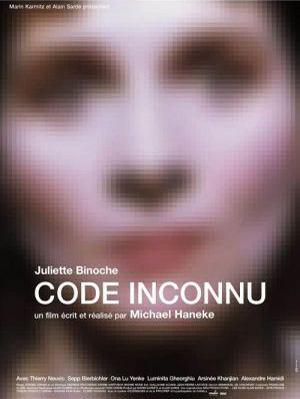
Code Unknown: Incomplete Tales Of Several Journeys (2000, Michael Haneke)
For my money Michael Haneke is one of the best working directors in the world right now; A man of such power yet exercising such restraint, and a man who's work with actors is of the highest order. His film Code Unknown is one which I hadn't seen in several years, one I knew I had to revisit again like I do most of his work. The film is an elliptical trip through the social unease in Paris as we see the clashing of ages, cultures, creeds, genders, and races. Of course you could swap Paris for any modern city boasting multiculturalism but Paris is Haneke's choice here, mostly due to the impression some of the city's house security had on him. In an interview on the DVD Haneke comments on how struck he was by finding that Parisian apartments have codes in which to enter, not keys or swipe cards, but codes. As he planned to take on the breakdown of communication amid modern society, this seemed to fit perfectly as a metaphor for all he aimed to accomplish. As expected, the acting on display is just stellar and simply untouchable, at the centre of it's many characters is a fine performance by Juliette Binoche who is part of what is for me the highlight of the entire film. As her character sits on the metro, from an unexplained A to B, she is harassed by two young Arab men. Their comments are assumed and spiteful, eventually forcing her to move to another area of the train, they inevitably follow. Shot in one static take (a much utilised Haneke trademark) and featuring no music (Haneke refuses to score his work), the scene is unbearably tense and accurately delivers the films message in a shockingly honest manner, a scene that is unfortunately relatable, as class, age, and race collide. Haneke's knack for building suspense isn't widely appreciated mostly due to the cold and disconnected approach to his shooting, But Haneke is a meticulous craftsman, a filmmaker of technical virtuosity (an extremely long dramatic take early on the the film is the perfect example of this) and is in constant control of his artistry. Code Unknown offers many insights into the modern world, from Bolivian poverty to Parisian 'highlife' this tale of incomplete journeys as the title suggest offers no answers, why should it? Life doesn't offer us explanations so how can cinema?
The Gold Rush (1925, Charles Chaplin)
A director remembered for so many great films, films that take the viewer on a vast journey of emotions, emotions stemming from its loveable on screen creator. The Gold Rush, amongst all of Chaplin's work, was the one he favoured most and was the one he wanted to be remembered for most. Though it rarely takes precedence over City Lights or The Great Dictator, The Gold Rush has always been placed at the top of such an illustrious career. It's strange to think of the film as Chaplin's champion; I would have placed many of his others if hazarding a guess but perhaps this marked a creative peak for him, the fact that it remains the only silent film of his that began shooting with the complete story mapped out shows insight into the planning and detail involved. What I love about this film is how purely enjoyable it is in its sense of adventure, none of Chaplin's silents are held down by their sociopolitical insights or their heart-tearing melodrama, yet The Gold Rush is the easiest to be swept along with. That said, it does contain one of Chaplin's most affecting scenes; as his lonely young prospector is stood-up by the woman he loves on New Year's Eve, the montage that follows stands just as powerful as anything else in his films.
This Is Spinal Tap (1984, Rob Reiner)
It goes without saying that This Is Spinal Tap is a comedic masterpiece, an unprecedented influence that just can't tire from as many repeat viewings you throw at it. This 'rockumentary' of an ageing/fading rock group drew inspiration from real life bands of the time; the creators courteously never named them but I can definitely muster a guess at Saxon and Whitesnake. The songs are ingeniously constructed, with painfully funny witty lyrics ("How can I leave this behind") and catchy to boot as they have you hampering for the OST. The naturalistic note perfect performances from McKean, Shearer, Guest, and the rest of the gang were severely planned through many series of conversations and note taking, before unleashing it in loose fashion in front of the camera to make room for improvisation, each actor could play off the other with their knowledge of where the scene could or should go. The results are just phenomenal and the feeling they stumbled on a recipe for gold by chance is probably one rooted in truth, the nature of the film meaning they couldn't recreate the magic exactly if they tried. With never a dull moment the film moves along with memorable quote after memorable scene, the laughs simply don'y stop until the screen is black. I was reminded of how spectacular the career of director/co-writer Rob Reiner from Spinal Tap in 1984, to the Oscar nominated success of A Few Good Men in 1992. A back to back canon of masterful wide reaching films that have etched themselves into the public conscience ever since. Along with Meg Ryan's fake orgasm, Spinal Tap's 'Stone Henge' stands at the top of the finest moments in not just comedy, but in any film.
The 400 Blows (1959, Francois Truffaut)
I can't think of another finer film depicting childhood than Truffaut's timeless debut. Bergman's Fanny & Alexander also deserves equal praise with Terrence Malick's The Tree Of Life as a more recent example. But Bergman and Malick - though much to their talent - were utterly ambitious and epic in scope despite their films humble and intimate moments. The 400 Blows is effortless in its simplicity, a film that is both lyrical and uplifting yet harsh and grounded, like childhood itself. The largely autobiographical film based on Truffaut's own childhood experiences has had a lasting effect on cinema which is evident in films as recent as This Is England. But Truffaut's film is influential to such a varying degree it overwhelms this writer to even begin to express its shaping of modern cinema. This film alone is one of the most praised French films on its own, when placed within the movement it helped start along with Alain Resnais' Hiroshima Mon Amour (1959) and Jean-Luc Godard's Breathless/À bout de souffle (1960) and its stature in film history is priceless. At its centre is a startlingly assured performance by then 15 year old Jean-Pierre Léaud, his role of the young Antoine Doinel he would reprise in the five films that followed depicting Antoine's further exploits as he enters adulthood. Scenes such as the gym teacher loosing his pupils one by one as they jog through the streets is as joyous to watch every time, the same goes for the boys taunting of their teacher behind his back as he recites literature. Against the childish glee that certainly runs through the film, there is the unavoidable fact that the story of Antoine is a tragedy. A tragedy that rings true as we see this misunderstood boy being neglected by his parents and eventually entering military reform schooling. In the first scene Antoine is caught in school with a picture of a pinup model being passed around the class, what at first seems like a common misunderstanding actually propels the boy on a dissent into further problems. The ending is one of the most beautifully understated pieces of cinema ever filmed; an extended tracking shot that dreamily never wishes to end before that famous freeze-frame officially stamping its melancholy finish, a perfect finish to a perfect film.
True Romance (1993, Tony Scott)
Revisiting True Romance had been on my mind for several months but it wasn't until the news of director Tony Scott's tragic demise last week that I made the extra effort to spin it one more time. The first script written by the now titan of cinema Quentin Tarantino, True Romance marks a career high for both its writer and director. With a stellar ensemble cast and a script that still feels fresh and punchy, it certainly hadn't dated as much as I feared it would have. Perhaps it's the fairytale quality to the violent couple on the run scenario that has reserved its shelf life; Hans Zimmer's somewhat reworking of Carl Orff's music for Terrence Malick's Badlands has a big hand in that factor, adding a removed dreamlike atmosphere throughout. When the opening credits began, I found myself overwhelmed by the back-to back talent; not many films boast the names Gary Oldman, Dennis Hopper, and Christoph Waltz in such quick succession, and that's not all. Brad Pitt turns in a rather hilarious comic performance as stoner roommate Floyd, but his like most of the performaces are fleeting if not memorable. Everyone has their time to shine before they quickly depart; Gary Oldman as the nasty pimp Drexl is just inspired, though not quite as inspired as the writing on display in the infamous 'Sicilian' speech delivered by Hopper to Walken's 'anti-christ' gangster Vincenzo Coccetti. That scene long served as the high point in Tarantino's career, a widely thought opinion that the director became frustrated with as time went on; a frustration that would lead him to consciously attempt to top it when writing the opening scene to his Inglourious Basterds. Whether he did in fact better the tense stand off of words in True Romance is debatable. Patricia Arquette is just adorable as Alabama, the call girl on the run with comic book/movie nerd Clarence (Christian Slater). Like Clarence's violent outburst towards Drexl, through his gentile exterior, she also is capable of grotesque acts despite appearing as sweet as her boyfriend's coffee. Her showdown with James Gandolfini's gangster stands as a major highlight in a film with many. Tony Scott does a wonderful job in telling Tarantino's story, the words jump off the actors lips in the lyrical way in which we've since become so used to. The choice to linearise the script was also wise, giving us characters to build with rather than confounding us in a redundant guessing game adding nothing to the story other than mere convolution.
Watch of the week: Due to there only being two films this week this is an almost impossible pick, however, due to it being a favourite of mine during my early teens and its lasting effect, True Romance wins. Tarantino claims the film as his most personal work and it's sure easy to see the genuine guise of personality, experience, and fantasy that he poured into his script.
Click here to read Dennis Hopper on the infamous scene he shared with Christopher Walken.
A Short Film About Love/Killing (1988, Krzysztof Kieślowski)
Further fleshed out into feature lengths from his TV-saga Dekalog: The Ten Commandments (1989), Krzysztof Kieślowski moulded two hauntingly emotional films dealing with adultery and murder. Love deals with a naive 19 year old orphan who spends his time obsessing and spying on the life of a female neighbour. Killing is the story of a young man's death sentence through his killing of a taxi driver, the film charts the soul crushing damage of capital punishment throughout the levels of the justice system. As expected from Kieślowski, both films are masterfully crafted pseudo-realist dramas benefitting from exemplary photography which transcends them beyond the likes of Ken Loach and into a realm that only the Polish auteur obtained. Killing in particularly is striking in its use of cinematography, often darkening areas of the frame with heightened use of muddy colours which gives the film a suitably suffocated and depraved feel. Both tales are tragic in their own way but I found Killing almost unbearably moving, the ripple effect caused by the convict's demise hits at such a gut level. The young lawyer defending the convict has his life devastated by the events, as he breaks down, this 86 minute film has you reeling for the poor man. Love is equally as impressive but on a more subtle level; the positions of control and eventual trading of perception/emotion between the voyeur and his subject is fascinating and superbly handled as the film reaches its anguished, ambiguous finale. As with every film in Kieślowski's career, these two films are nothing short of masterpieces and two of the finest examples of European cinema.
Scenes From A Marriage (1973, Ingmar Bergman)

Again edited from a television series, Scenes From A Marriage remains one of Ingmar Bergman's finest achievements in a career of unprecedented quality. At first shown on Swedish television in six episodes, the original 299minutes version was edited down for a 167minute theatrical-cut, the cut I watched this week. Never has a filmmaker got to the essence of what makes humans tick like Bergman did, his insight into our flaws and grace ran so deep it's no wonder the great man had to change his phone number after the film's release, receiving a barrage of calls seeking marital guidance. His film struck a chord with Sweden before taking on the world, in the year of its release divorce rates doubled! This sounds like the film is a cynical preach about the suffocating nature of marriage but this is not the case at all; despite reaching unbearable tension and ugliness the film in it's depiction of Marianne (Liv Ullmann) and Johan's (Erland Josephson) marriage is life affirming despite its devastating facade. We pick up in their lives ten years into marriage, their reaction to their best friend's divorce, Johan's affair, their separation, then their efforts to rekindle a love though know can never be extinguished. If Bergman is trying to get across his point, that point is that marriage (as well as any repeated social construct) can only destroy a love that is destined between two people. Bergman's career covers the void between two souls time and time again, the distance we have even within ourselves, the art of communication is one which we simply haven't mastered yet. In our connection with others, or simply in our silence, we effect one another in more ways than we can imagine. Though we crave human connection we are but foreign entities that don't meld, the beauty of course is in the trying. As Marianne and Johan remarry to new partners their love remains, the scene between them as they spend an intimate night together as their new spouses are away is so touching and real it's almost incomprehensible how much Bergman knew and loved his characters. He understands them at their best and worst, accepts them as such, and treats them with upmost respect. Never at any time does the film judge either character and with Scenes Of A Marriage, never has acting been displayed quite like this. Ullmann and Josephson's performances are so detailed, natural, and utterly realised that the relationship feels strikingly candid as you feel these two humans have really loved each other for 10years. A draining but revealing masterwork, Scene From A Marriage is as relevant and important today as it ever was; Another 50 years on and the same will still stand.
Diary Of A Country Priest (1951, Robert Bresson)
My journey into the cinema of Robert Bresson has so far been a divided one, A Man Escaped was for me, a masterpiece, while Pickpocket just failed to live up to its reputation. With Diary Of A Country Priest I'm happy to be impressed once again, so much so that this has been my favourite Bresson so far. The film charts the difficult dealings between a dying young priest and the community he's recently settled down in. The life of a priest is one which most must decide is an easy one without much further thought, I can certainly empathise with the strain put on such a profession mostly due to the sadly cruel behaviour of most small communities and the upstanding the social role requires. A priest must be a model of perfection that cannot afford to appear as human as the rest of a parish, through succeeding or slipping in this performance of perfection society will judge nonetheless. As this young man struggles to fulfil his role and take on various problems while facing his own illness, he is adjudicated at every turn; when scrutinising eyes are on you, can you ever be right? The film is honest and affecting without any of the usual cinematic cushioning that Bresson despised, he refused to evoke emotional responses through the typical use of music and heightened acting. It's a fascinating look into a life largely ignored social position due to conflicting belief systems, people simply don't care about the hardships of a priest. Cinema is the tool in which to experience different perspectives and personal trials, in a bid to understand and widen our world view cinema is a powerful tool indeed. With this film Bresson does his character and story full justice.
Easy Rider (1969, Dennis Hopper)
Among the unfortunately short lived career of producer Bert Schneider is Easy Rider, a loose low-budget, drug fuelled and rather dog-eared film that changed American cinema forever and for the better. Taking after the French new-wave of the previous decade, Easy Rider killed the ways of the old studio system over night and brought in the 1970s American renaissance. This 'New Hollywood' remains the most artistically prosperous in the history of American film, a short time that's never been bettered in terms of game changing influence. The tagline, "A man went looking for America. And couldn't find it anywhere", sums up the films' ethos rather well. In a time of great uncertainty, controversy, and rapid social change, the young became lost in their new youthful freedom. Yet this new youth raised on music and drugs were not yet understood or accepted by society, a point drilled home by Easy Rider's tragic end. Now iconic imagery, Dennis Hopper and Peter Fonda cross America on their motorbikes and meet various characters across the way, discussing their outlooks on life and their country. Jack Nicholson steals the show as an alcoholic businessman who's repoire with the local law enforcement gets them out of jail. The joke (though not a funny one) being that the law respect Nicholson's troubled character for the suite he wears, whereas they have nothing but distain for the other two long-haired hippies. As far as films go you can't do much better than Easy Rider to depict counter culture phenomenon, it acts as a time capsule of thought and imagery that feels true and everlasting in relevance. The famed 'acid sequence' towards the end of the film is just stunning, a haunting meltdown of emotion that feels all too candid and personal in nature. Easy Rider is cinematic catharsis in its rawest form.
Five Easy Pieces (1970, Bob Rafelson)
After his show stealing role in Easy Rider, Jack Nicholson was given his own vehicle to show off with by producer Bert Schneider. The story of a drifter from a privileged musical background nomadically traveling from menial job to menial job is a lamentable case of identity, and a man running endlessly from himself. When viewed now, the similarities with Sean Penn's brilliant Into The Wild (2008) are striking. When we're introduced to Nicholson he's an philandering, heavy drinking oil worker; we know nothing at first about his past or much of his character besides flaws, as we follow him as he visits his family home after his father is taken ill, we see the roots of this troubled soul and why he's so alienated and uneasy with himself. Nicholson's performance as Bobby Dupea is a career best, a fairly restrained performances for his standards, one shrouded in mystery and yet completely sympathetic.
It's not worth complaining about the injustice of Five Easy Pieces being too little seen/mentioned next to other greats, given the sheer amount of productivity of the era there was always going to be a few examples of brilliance lost in the wave of creativity that was the 70s renaissance. It's worth remembering just how spectacular Nicholson's work during the 70s was, beginning with Easy Rider and ending with The Shining (1980), the run of films during this time is beyond impressive in quality and influence.
Ivan's Childhood (1962, Andrey Tarkovskiy)
The phrase, "war is no place for a boy", is stated on more than one occasion during Ivan's Childhood. These words often said by the very people manipulating him for their war efforts, simply saying this when his use has run out. These asinine words stand at the height of hypocrisy, on one level through the people who utter them actively involving Ivan in the war, while in a wider view the fact remains that no one escapes the horrors when war breaks out, the war belongs to everyone and yet no one.. At the heart of the film is an incredibly potent performance by 15 year old Nikolay Burlyaev as Ivan, a boy left with nothing due to the casualties of war, the tragedy is Ivan filling his despairing void with the very war that caused it. Burlyaev plays Ivan with a steel conviction, making Ivan a hardened man within a shell of adolescence. Tarkovsky's film has a dream like quality to it, a nightmare rather, as you expect any of the characters to wakeup from the horror at any second. The film does indeed include dream sequences, the opening one in particular is truly affecting, but it's the disorientating and imprinting finale that stays with you here. Along with Kubrick's Paths Of Glory (1957), Ivan's Childhood is perhaps the greatest attack on war by a film yet.
Watch of the week: For it's unparalleled performances and timeless relevance to anyone who's ever been in a relationship, Scenes From A Marriage is my pick of the week. A film which stands tall among the many great works of visionary Ingmar Bergman, a filmmaker who never stopped giving, even after his passing.
The Rules Of The Game (1939, Jean Renoir)
Due to the recent results of Sight & Sound's Top 50 Greatest Films I've found myself compelled to revisit various films; to reanalyse the stature and appeal of some regarding their placing on the list, with others due to the desire to experience timeless examples once again. Whereas I need no encouragement to come back to The Passion Of Joan Of Arc, or Vertigo time and time again, I felt drawn to Renoir's The Rules Of The Game to decide for myself whether it deserves the title of '4th greatest film of all time' - a title also making it the 'greatest French film of all time'. Upon second viewing I believe it does deserve its newly confirmed status as such; though the allegorical insight into French bourgeoisie morals on the eve of World War II may be harder to decipher when viewed today, it certainly hasn't lost any of its marvel due to the widening scope of this fine film's vision. Working as a comedy of manners, a doomed love story, and satire to the upper classes; The Rules Of The Game can be enjoyed on any of these levels. What took me aback this time was just how fresh the film feels, the dialogue is rich and naturalistic while never dull for a second. Renoir's direction is also a wondrous achievement with his voyeuristic fluid camera observing events in a stylised fashion but one which never takes away from character and story. His composition (making great use of the expansive rooms which the characters occupy) manages to be both impressive but never distracting, the mark of a masterful director. The fact that The Rules Of The Game is a top 10 staple of most critics, directors, and scholars is of no surprise due to its historical insights, technical innovation, and lasting entertainment.
A Man Escaped (1956, Robert Bresson)
One of the most important films from one of the most important directors ever. Having noted and respected the sheer impact of Bresson's film while studying for my degree, I was hardly moved by it at all on first viewing. Maybe this was due to seeing it as a standalone with no prior knowledge or exposure to Bresson's work, as his films are most rewarding when viewed within the context of an auteur. When you understand where he's coming from artistically, when you learn about his background and key concerns, then you unlock the key to why he's so heavily regarded as one of the finest filmmakers to ever have lived. A Man Escaped - like all of Bresson's work - is stripped of all artifice but contain so much more than meets the eye, this simple but true tale of a French resistance fighter's elaborate escape from a POW camp during WWII can be viewed in many ways depending on the spectator. For me, it's a tale of redemption and the difficult (as well as lonely) path to salvation, but what is often forgotten in Bresson's work is his command of suspense, a vital ingredient that A Man Escaped utilises with great effect. Perhaps the lack of applause for Bresson's knack for thrillers stems from his intensely minimalist and almost non-cinematic style, though no one can make a case for his work lacking any cinematic splendour with the displays of rich photography and use of music (here Mozart's Great Mass in C Minor). As we follow our protagonist planning day in day out the means to an escape, despite learning nothing of his character or backstory, or even what he's been imprisoned for, you connect with his situation. Bresson's withholding of information and naturalistic performances has us project ourselves onto his characters; at one point our 'hero' is told he will be executed the next morning, not sure whether he'll be moved to another room thus making his plans and effort after all these months ineffectual and leading him to certain death, the suspense has your heart stop beating as his does. A Man Escaped is just one of many praised works by Bresson but it's with this film that he's most known within the history of cinema, perhaps his ever developing style coupled with relatable material (based on the memoirs of POW Andre Devigny, Bresson was also captured during wartime) made for a lasting masterpiece, one with a lasting effect still felt today.
Pickpocket (1959, Robert Bresson)
The second film of Robert Bresson I watched this week, though the thrills and transcendent nature of A Man Escaped once again confirmed said film a masterpiece, I sadly can't say the same for Pickpocket. Widely considered one of Bresson's better films and certainly one of his most influential, I could only see its lasting legacy on cinema without seeing any appeal or cause for appraisal. This slight updating of Dostoevsky's Crime & Punishment follows a young thief, his philosophies on a Darwinism of sorts, and the detective closing in on him. While Bresson's cinema is one of a minimalist quality, Pickpocket felt devoid of any connection whatsoever. The decision to apply Dostoevsky's tale to a smalltime (yet skilled) thief loses all weight when compared to Raskolnikov's murderer, also the casting of non-actor Martin LaSalle as thief Michel is problematic due to his vapid screen presence, offering no engagement to make concern for his future possible. The much needed chemistry between LaSalle and female (romantic) lead is also gravely lacking. Though early scenes showing Michel's thefts are well handled suspenseful examples that go in the film's favour, all is lost by the time Pickpocket reaches halfway through its mere 75minute runtime. Pickpocket is interesting when viewed on the merit of its lasting influence as without it we perhaps wouldn't have Taxi Driver, its resemblance to Christopher Nolan's low-budget debut Following (1998) is also apparent, and for this alone Pickpocket has more than earned its keep.
Une Femme Est Une Femme (1961, Jean-Luc Godard)
Godard's first foray into colour in which he uses his new palette as if it's going out of fashion. The most joyous and accessible of his work, Une Femme Est Une Femme follows Angela (played by a never more lovely Anna Karina) a striptease artist desperate for a baby. Boyfriend Emile (Jean-Claude Brialy) is against the idea and as the couple continue to argue he says half-heartedly that she should seek assistance from his friend Alfred (Jean-Paul Belmondo) if a baby means that much to her. Emile, not realising the extent to which Angela will go to, nor that his best friend is in love with her, sets himself up for a fall in his ignorance and insensitive manners. Godard never allows the plot to ever become heavier than a grain of salt though, yet he manages to include insights into adult relationships without ever taking us aside to announce them. The playful tone of the film has much to do with Godard's homage and deconstruction of the musical and romantic comedy genres, Godard's experimental editing technique and bold use of music keeps you on your toes throughout with its oddball effects showcasing the frustrating genius of the director. The sight of Anna Karina playacting pregnancy in front of the mirror with an obscenely large cushion cracks me up every time, seeing Brialy continue to argue while riding a bike in the living room is just another example of how childish Godard's characters are. Perhaps this is the film's main point, that as we grow older and take on important adult decisions our childish pettiness (and selfishness) still remain, that an adult is merely a child with more layers. A perfect place to start when exploring the cinema of Anna Karina, her many collaborations with (then lover, later husband) Godard, and as well as the timeless À bout de souffle (1960) the best place to being with Godard's work in general. At one point during the film Angela is asked what she's thinking, she replies, "I'm thinking that I exist", after Une Femme Est Une Femme is through you'll certainly be thankful she does.
Fort Apache (1948, John Ford)
The only film I've watched this week that doesn't happen to be French is John Ford's Fort Apache; the first part of Ford's 'Calvary Trilogy', the tale matches two screen icons and Ford regulars in a battle of ego and alpha male showmanship. Henry Fonda plays a Lieutenant Colonel Owen Thursday - a general of The Civil War who's higher command have transferred him to manage the Fort Apache post which John Wayne's Captain Kirby York was expected to take control of. What transpires is a test of honour as Thursday's lack of experience with the Apache Indians puts their operation in peril, York has the experience and the respect of the fort's men to carry their duty out successfully and must face up to the stone wall of his new commander. It's a fun adventure with laughs and romance (Shirley Temple plays Thursday's plucky daughter) with a brilliant supporting cast and a rare icy performance from Fonda who plays the grudge baring Thursday to perfection. Despite the fact that Ford made black & white masterpieces such as Stagecoach (1939) and The Grapes Of Wrath (1940), I've always felt that his pictures took on new levels once he utilised colour; here his beloved Monument Valley lacks that mythic quality in monochrome, the setting for all his westerns. The fact that Fort Apache feels like rather minor Ford is testament to the man's legacy and tremendous body of work he left behind, because the film really is a great entertainment that pitches two of Hollywood's finest screen actors against each other. Ford, Fonda, Wayne, how can you say no to that any day of the week?
Watch of the week: With its joyous tone, ridiculous humour, and gorgeous photography and set design, my pick of the week goes to Une Femme Est Une Femme. I so wanted to say The Rules Of The Game but with Anna Karina's seductive fluttering eyelashes it just didn't seem possible after all.